


Pico Maccario
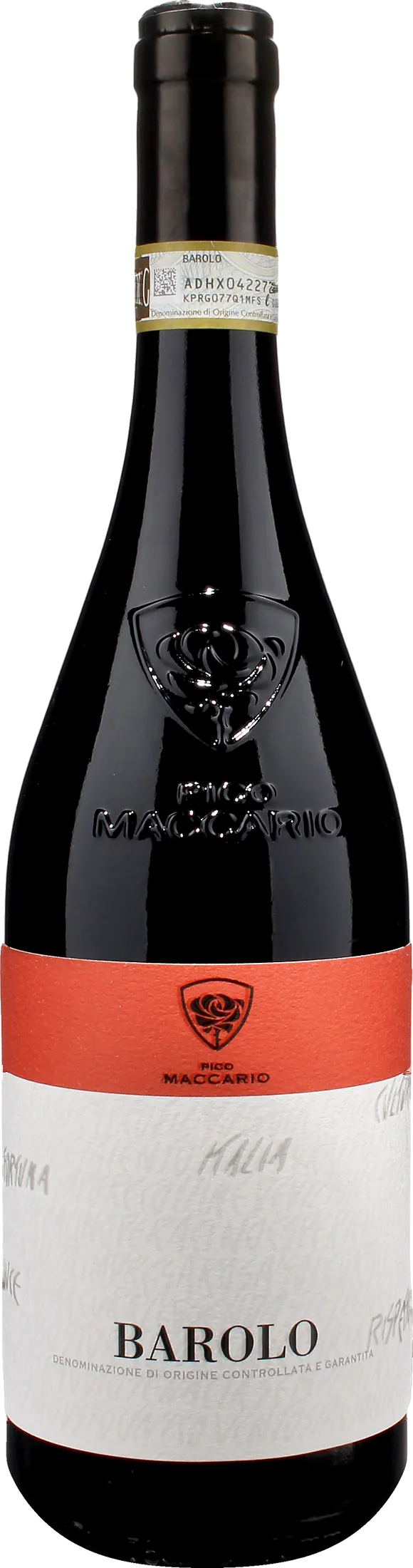
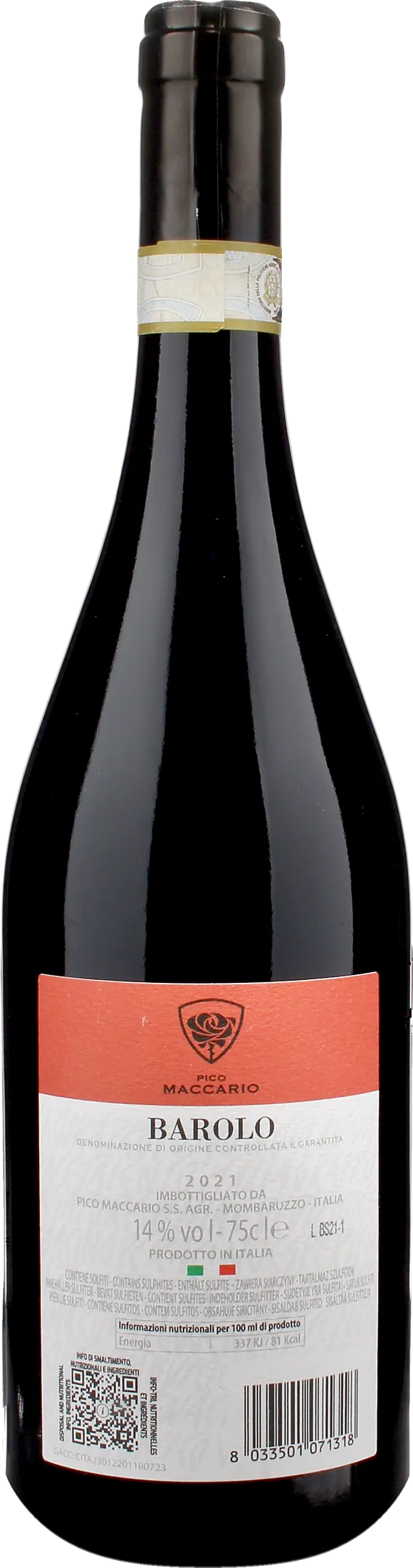
Barolo 2021
| Denomination | DOCG Barolo |
|---|---|
| Size | 0,75 l |
| Alcohol content | 14.0% by volume |
| Area | Piedmont (Italy) |
| Grape varieties | 100% Nebbiolo |
| Aging | Aged for 18–20 months in large traditional Slavonian and French oak casks, followed by at least one year of bottle ageing before being released for sale. |
- Designation and grape: Dry red wine DOCG from 100% Nebbiolo grapes
- Vintage and size: 2021, 0.75 l; alcohol content 14–14.5% vol
- Aromatic profile: Notes of ripe cherry, dried rose, leather, tobacco and spices
- Vinification: In stainless steel at 28–30°C; maturation for 18–20 months in oak barrels
- Taste and service: Elegant tannins, mineral finish; serve at 18°C, decant for 1 hour
Description
What kind of wine it is
The Barolo Denominazione di Origine Controllata e Garantita by Pico Maccario is a still red wine from Piedmont, made from Nebbiolo grapes. This expression of Barolo is distinguished by a structured profile and a dense yet fine-grained tannic texture. In the glass, it shows a bright garnet red colour, enriched by hints of ripe cherry, small dark berries, dried rose, leather, tobacco and delicate earthy nuances. On the palate, it is deep, enveloping and elegant, with a long, mineral finish, enhanced by fermentation in steel and ageing in oak barrels which ensure an excellent potential for ageing.
Where it comes from
The grapes grow among the hills of the Langhe, at an altitude of between 250 and 300 metres. The limestone-clay soils, rich in marl and sandy veins, give the wine a distinct mineral depth and a significant structure. The local microclimate, characterised by a good temperature range between day and night, favours a slow ripening of the clusters, preserving their natural freshness. Produced by Pico Maccario, this wine faithfully interprets the identity of the premier terroir of Barolo.
How it is produced
Production begins with a manual harvest and a meticulous selection of the clusters. Following gentle pressing and destemming, fermentation takes place in temperature-controlled stainless steel tanks. The maceration on the skins phase lasts for about fifteen days, with frequent punching down and gentle pump-overs to extract the best of the fruit. Subsequently, the wine ages for eighteen to twenty months in large Slavonian and French oak barrels, finally completing its journey with a rest of at least one year in the bottle.
History and curiosities
This Barolo originates from an interesting peculiarity: it is produced in Mombaruzzo, in the province of Asti, a territory where Barbera is considered the queen. In this area, however, Nebbiolo finds an equally noble expression, being produced with great passion and dedication by the Maccario family.
Tasting notes

Perfume

Color

Taste
Serve at:
18 - 20 °C
Longevity:
10 - 15 years
Decanting time:
1 hour
- Start up year: 1997
- Oenologist: Roberto Olivieri
- Bottles produced: 800.000
- Hectares: 100
Since 1997 it has been run by the two brothers Pico and Vitaliano Maccario who have been able to combine the main native vine also with international vines. Thus, most of the 85 hectares of vineyards are dedicated to Barbera, then subdivided into Merlot, Cabernet Sauvignon, Chardonnay, Sauvignon, Freisa and Favorita.
The company is in contemporary style both in the management of the vineyards and in the technological innovations in the cellar. Even the logo is very innovative with a stylized rose that wants to indicate its position instead of traditional and important next to each row.
We are pleased to officially inform you that the Barbera d'Asti Lavignone 2023 has been awarded the Tre Bicchieri® of the guide Vini d'Italia 2025. An achievement that also this year confirms the loyalty of our customers and our continuous commitment to guarantee, from the vineyard to the glass, the highest quality that distinguishes us. Read more


| Name | Pico Maccario Barolo 2021 |
|---|---|
| Type | Red still |
| Denomination | Barolo DOCG |
| Vintage | 2021 |
| Size | 0,75 l |
| Alcohol content | 14.0% by volume |
| Grape varieties | 100% Nebbiolo |
| Country | Italy |
| Region | Piedmont |
| Vendor | Pico Maccario |
| Story | History and curiosities This Barolo originates from an interesting peculiarity: it is produced in Mombaruzzo, in the province of Asti, a territory where Barbera is considered the queen. In this area, however, Nebbiolo finds an equally noble expression, being produced with great passion and dedication by the Maccario family. |
| Origin | Langhe (Barolo), Piedmont, Italy |
| Climate | Microclimate with cool nights and warm, sunny days, which allows for slow and optimal ripening of the grapes for freshness and structure. |
| Soil composition | Soils rich in limestone and marl; predominantly calcareous-clayey with sandy veins |
| Cultivation system | Guyot |
| Fermentation temperature | 28 to 30 degrees Celsius |
| Fermentation | About 15 days |
| Production technique | Manual harvesting with selection in the vineyard; gentle pressing and destemming; fermentation in temperature-controlled stainless steel tanks with maceration on the skins; maturation for 18–20 months in large oak casks (Slavonian and French) followed by further ageing in the bottle. |
| Wine making | Manual harvesting and selection in the vineyard; soft crushing and de-stemming; fermentation in stainless steel tanks at a controlled temperature (28–30°C) with maceration on the skins for approximately 15 days, frequent punching down and gentle pump-overs; ageing for 18–20 months in large traditional Slavonian and French oak barrels, followed by at least one year of bottle ageing before commercialisation. |
| Aging | Aged for 18–20 months in large traditional Slavonian and French oak casks, followed by at least one year of bottle ageing before being released for sale. |
| Allergens | Contains sulphites |