


Cantina Mesa
Vermentino di Sardegna Opale 2025
| Denomination | DOC Vermentino di Sardegna |
|---|---|
| Size | 0,75 l |
| Alcohol content | 14.0% by volume |
| Area | Sardinia (Italy) |
| Grape varieties | 100% Vermentino |
| Aging | Ageing in concrete tanks on the fine lees. |
- Denomination and origin: Typical white from south-western Sardinia, Sulcis area
- Vinification: Bush-trained vines, maturation in concrete on the noble lees
- Aromas: Ripe yellow fruit, Mediterranean herbs, sweet spices and briny hints
- Taste: Smooth texture, balance between freshness and savouriness, persistent mineral finish
- Pairings: Ideal with flavourful fish and white meats. Alcohol content 14%, size 0.75 l
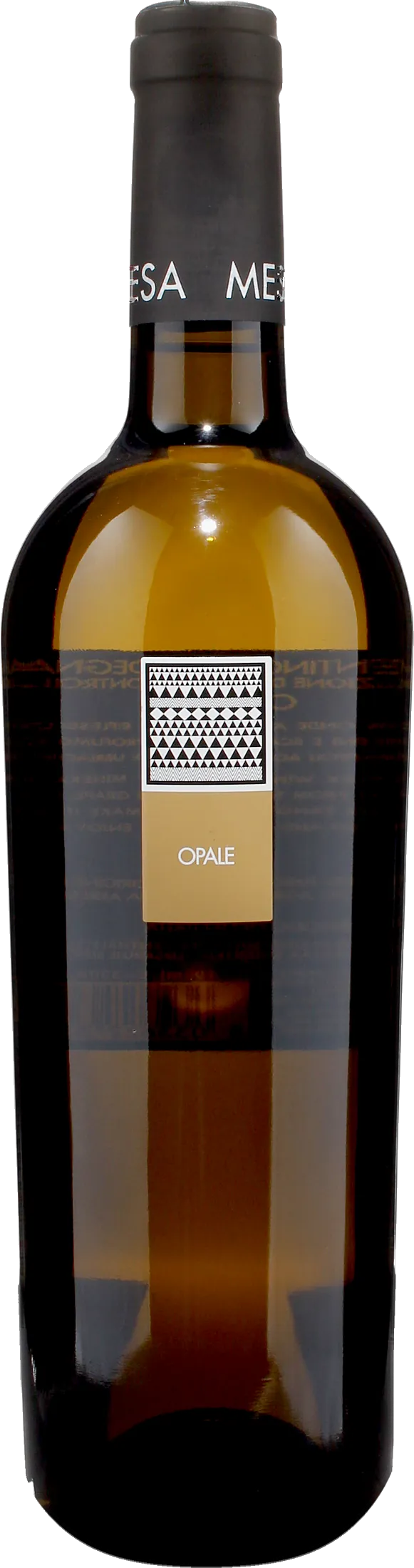
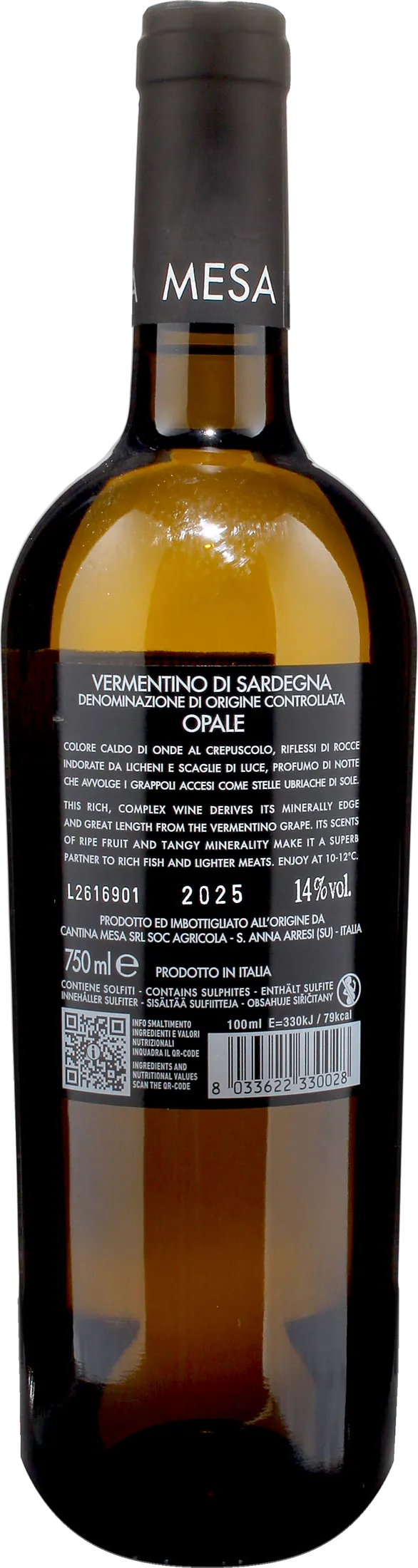
Description
What kind of wine it is
Mesa Vermentino di Sardegna Opale from Cantina Mesa is a still white wine produced in the renowned Sardinian regional denomination. Made entirely from Vermentino grapes, this wine fully expresses the sunny and maritime character of the island territory. On the palate, it presents as a structured and complex glass, characterised by an intense aromatic profile in which notes of ripe yellow fruit, hints of Mediterranean scrub and distinct iodised nuances stand out. Its careful evolution in concrete on the lees gives it a silky texture that perfectly balances its freshness and savoury imprint, making it ideal for accompanying strongly flavoured fish dishes or light meats, lingering in an energetic and mineral finish.
Where it comes from
This Sardinian white comes from Sulcis, an area located in the south-western tip of Sardinia, almost entirely surrounded by the sea. The distinctly Mediterranean climate, with low rainfall concentrated in the winter months and high temperatures in summer, forges the robustness of the vines, which are constantly cooled by the mistral winds. The terrain shows considerable variability, alternating between sandy areas and clay-limestone soils rich in stony fragments, with a sub-alkaline reaction. The constant maritime influence blends with the evident mineral richness of the land, giving the clusters a marked savoury imprint and guaranteeing the wine an unmistakable personality, which faithfully reflects the ruggedness and charm of the landscape of origin.
How it is produced
The winemaking process begins with a meticulous harvest conducted between the second and third ten-day periods of September, gathering grapes grown using the traditional bush-vine (alberello) and spurred cordon systems. After the delicate pressing and fermentation stages, the wine is transferred into concrete containers, a technical material chosen to preserve the authenticity of the varietal aromas. During the ageing period, the wine remains in close contact with the noble lees, a fundamental oenological practice that increases aromatic complexity and softens the structure of the palate. This careful rest allows for perfect gustatory harmony, enhancing the natural freshness and savouriness without resorting to maturation in wooden containers.
History and interesting facts
Cantina Mesa's Opale expresses the purest soul of Sulcis, guardian of a winemaking heritage of the highest prestige. The vines thrive through the historic bush-training technique on clay-limestone soils, yielding vigorous clusters harvested in late September. A fascinating detail lies in its maturation within concrete tanks, where contact with noble lees enhances its aromatic complexity. This constant pursuit of perfection boasts illustrious accolades, including 93 points from Luca Maroni and four Bibenda bunches, symbols of pure elegance.
Tasting notes

Perfume

Color

Taste
Serve at:
06 - 08 °C
Longevity:
03 - 05 years
- Start up year: 2004
- Oenologist: Stefano Cova
- Bottles produced: 650.000
- Hectares: 73
In these valleys, characterised by sandy soils, wines of great character and luminosity are born, starting with the most typical grape varieties of the area: Carignano, Cannonau and Vermentino. In the heart of Sulcis, Cantina Mesa now has 73 hectares under vine - 66 of which are its own - where the vines are trained to the head-training or spurred cordon system.
The winery is in the village of Sant'Anna Arresi, the right place to create an ideal contrast with the terroir to create wines in all their nuances. This village is a candid, unusual and minimalist structure, surrounded by gentle hillsides and silhouetted amidst the green Mediterranean scrub.
Then, the winery is about 5,000 square metres, spread over three levels and arranged so that grapes and wine can be treated with the utmost respect and special care: no mechanical pumps, therefore, but movements that take place through the principle of "natural fall". Lastly, the ageing process is carried out in the basement of the cellar. This is how all the wines labelled Mesa are born, with names loaded with meaning such as "Buio", "Giunco", "Buio Buio" and "Opale", to continue with all the others. Territorial, integral, punctual and precise wines are the faithful expression of a region that is second to none when it comes to wine. Read more


| Name | Mesa Vermentino di Sardegna Opale 2025 |
|---|---|
| Type | White still |
| Denomination | Vermentino di Sardegna DOC |
| Vintage | 2025 |
| Size | 0,75 l |
| Alcohol content | 14.0% by volume |
| Grape varieties | 100% Vermentino |
| Country | Italy |
| Region | Sardinia |
| Vendor | Cantina Mesa |
| Story | History and interesting facts Cantina Mesa's Opale expresses the purest soul of Sulcis, guardian of a winemaking heritage of the highest prestige. The vines thrive through the historic bush-training technique on clay-limestone soils, yielding vigorous clusters harvested in late September. A fascinating detail lies in its maturation within concrete tanks, where contact with noble lees enhances its aromatic complexity. This constant pursuit of perfection boasts illustrious accolades, including 93 points from Luca Maroni and four Bibenda bunches, symbols of pure elegance. |
| Origin | Sulcis, in the south-western extremity of Sardinia (Italy) |
| Climate | Mediterranean: sparse and intermittent precipitation concentrated in the autumn and winter seasons, frequent gusts of the mistral wind, high temperatures between spring and summer, temperate autumns and winters ranging from cold and dry to mild. |
| Soil composition | Soil of a sandy and calcareous-clay nature, rich in coarse fragments, medium-textured, with a fair supply of organic matter, a sub-alkaline reaction and a good mineral content. |
| Cultivation system | Spurred cordon |
| Yield per hectare | 65 quintals per hectare |
| Harvest | Between the second and third ten-day periods of September |
| Production technique | Bush-vine training; maturation in concrete tanks with contact with the fine lees |
| Wine making | Ageing in concrete tanks with contact on the fine lees. |
| Aging | Ageing in concrete tanks on the fine lees. |
| Allergens | Contains sulphites |