


Villa Raiano
Falanghina 2025
| Denomination | IGT Beneventano/Beneventano |
|---|---|
| Size | 0,75 l |
| Alcohol content | 13.0% by volume |
| Area | Campania (Italy) |
| Grape varieties | 100% Falanghina |
| Aging | Fermentation and maturation in stainless steel on fine lees for 4 months; generally bottled in February following the harvest. |
- Origin: 100% Falanghina from Torrecuso, Beneventano IGT, Campania.
- Style: Still white wine, bright straw yellow in colour, with a taut and elegant palate.
- Aromas: Notes of citrus fruits, pineapple, white peach, wild herbs and a slight mineral hint.
- Vinification: Fermentation in steel at 16°C and ageing for 4 months on fine lees.
- Pairings: Serve at 10-12°C with fish, fried dishes, fresh pasta and vegetarian dishes.
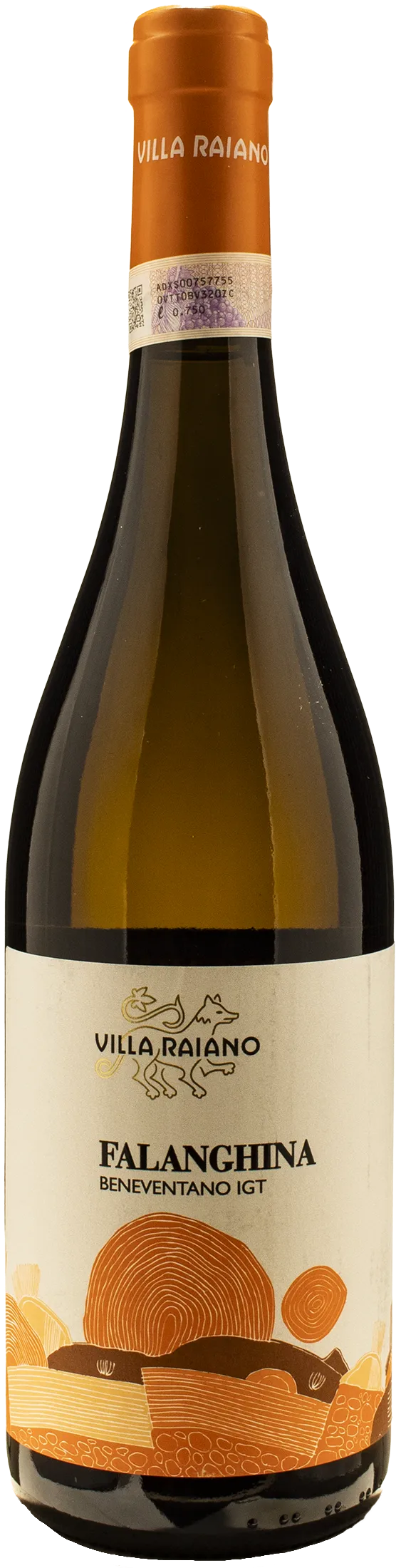
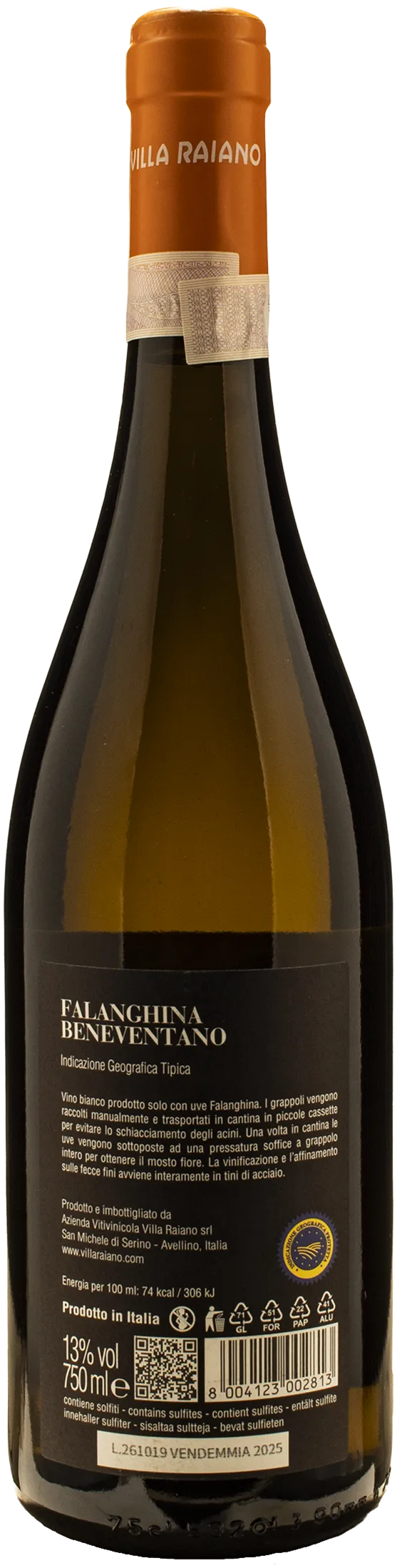
Description
What kind of wine it is
Villa Raiano Falanghina Beneventano is a still white wine from Campania, characterised by a taut and elegant sip. Made from Falanghina grapes, it displays a bright straw yellow colour and a harmonious sensory profile. On the nose, clear citrus aromas emerge, along with pineapple and white peach, complemented by pleasant hints of wild herbs. On the palate, it reveals a defined structure where freshness and savouriness lead the tasting towards a full and dry finish.
Where it comes from
The vines grow in the area of Torrecuso, within the Taburno Park. Trained using the Guyot system at altitudes between three hundred and four hundred metres, the rows sink their roots into calcareous-clay soils with sandy and volcanic components. This particular geological matrix, combined with the local microclimate, allows for optimal yield management and excellent aromatic concentration. The environment imparts a distinct savoury and mineral character to the glass, expressing the identity of the territory.
How it is produced
Harvesting is done by hand to preserve the integrity of the bunches. In the winery, a gentle whole-bunch pressing is carried out, followed by static decantation of the must. Fermentation takes place in stainless steel tanks at controlled temperatures with selected yeasts. Maturation continues on the fine lees for four months, giving the wine greater texture. Part of the batch may briefly mature in barrels to acquire further complexity before the final blend is created.
History and Curiosities
Founded in 1996 by the Basso family within an ancient olive mill, Villa Raiano now stands amidst vineyards and chestnut groves overlooking the Sabato river valley. This excellent Falanghina Beneventano IGT is produced from grapes grown in Torrecuso, in the Taburno Park, and harvested entirely by hand. Maturation in steel on fine lees enhances its varietal essence, already multi-award-winning at the Sommelier Wine Awards. An elegant white wine that reveals a vibrant mineral texture, an authentic expression of Campania's vocation.
Tasting notes

Perfume

Color

Taste
Serve at:
10 - 12 °C
Longevity:
03 - 05 years

- Start up year: 1996
- Oenologist: Sebastiano Fortunato
- Bottles produced: 320.000
- Hectares: 30
The current cellar, built in 2009 on top of a hill in San Michele di Serino (AV), is the core of our company. A modern structure, perfectly integrated into the immediate environment, surrounded by vineyards and chestnut woods. From the panoramic terrace, with a view, you can follow the entire Sabato River valley, from its source, at the foot of Monte Terminio, to the point where it leaves the province of Avellino in Altavilla Irpina. Read more


| Name | Villa Raiano Falanghina 2025 |
|---|---|
| Type | White still |
| Denomination | Beneventano/Beneventano IGT |
| Vintage | 2025 |
| Size | 0,75 l |
| Alcohol content | 13.0% by volume |
| Grape varieties | 100% Falanghina |
| Country | Italy |
| Region | Campania |
| Vendor | Villa Raiano |
| Story | History and Curiosities Founded in 1996 by the Basso family within an ancient olive mill, Villa Raiano now stands amidst vineyards and chestnut groves overlooking the Sabato river valley. This excellent Falanghina Beneventano IGT is produced from grapes grown in Torrecuso, in the Taburno Park, and harvested entirely by hand. Maturation in steel on fine lees enhances its varietal essence, already multi-award-winning at the Sommelier Wine Awards. An elegant white wine that reveals a vibrant mineral texture, an authentic expression of Campania's vocation. |
| Origin | Municipality of Torrecuso, province of Benevento |
| Soil composition | Clay-calcareous loam and silty-sandy loam; volcanic influences |
| Cultivation system | Guyot |
| Plants per hectare | 4500 |
| Yield per hectare | 80 quintals per hectare |
| Harvest | Between the second and third week of September |
| Fermentation temperature | 16 °C |
| Production technique | Soft whole-bunch pressing; static decantation of the must; fermentation and ageing in stainless steel on the fine lees for 4 months |
| Wine making | Soft pressing of whole bunches; static decantation of the must; inoculation with selected yeasts; fermentation in stainless steel tanks at 16°C; ageing on fine lees for 4 months in stainless steel; bottling generally in February following the harvest. |
| Aging | Fermentation and maturation in stainless steel on fine lees for 4 months; generally bottled in February following the harvest. |
| Allergens | Contains sulphites |