


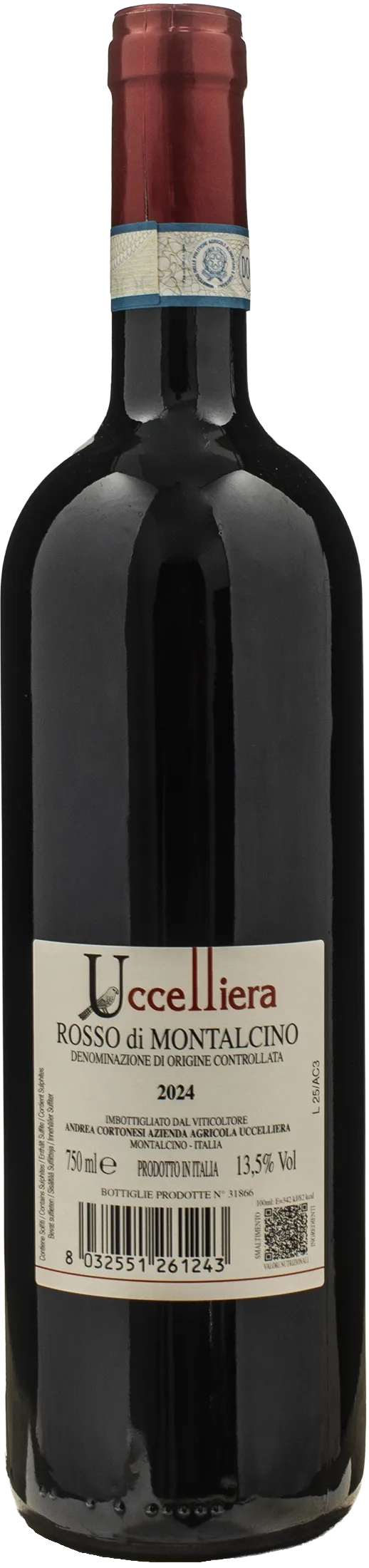
Uccelliera
Rosso di Montalcino 2024
| Denomination | DOC Rosso di Montalcino |
|---|---|
| Size | 0,75 l |
| Alcohol content | 13.5% by volume |
| Area | Tuscany (Italy) |
| Grape varieties | 100% Sangiovese |
| Aging | Maturation in Slavonian and French oak containers of various sizes for several months, followed by a further refinement of at least 4 months in the bottle. |
- Name and grape: Rosso di Montalcino DOC 2024, 100% Sangiovese
- Natural vinification: Spontaneous fermentation with indigenous yeasts for 25–30 days
- Aged in wood: In Slavonian and French oak, plus 4 months in bottle
- Origin and soils: Castelnuovo dell’Abate (150-350m) on clay-limestone soil with marl
- Recommended pairings: Roasts, grilled meats, slow-cooked pork and mature cheeses

Description
What kind of wine it is
Uccelliera Rosso di Montalcino is a still red wine that clearly expresses the authentic character of Sangiovese. This label, a true reflection of the Rosso di Montalcino region, stands out for its distinct and balanced profile, managing to combine a defined structure with a pleasant smoothness. Its gastronomic vocation makes it extremely versatile, proving to be the ideal accompaniment for flavourful meat dishes such as roasts, grilled meats and pork-based preparations, as well as excellently enhancing platters of mature cheeses.
Where it comes from
This Tuscan wine originates from Castelnuovo dell’Abate, in the renowned south-eastern area of Montalcino. The vineyards of the Uccelliera winery, managed according to the principles of organic and sustainable agriculture, are situated at an altitude between one hundred and fifty and three hundred and fifty metres above sea level. The vines are trained using the spurred cordon and Guyot methods on clay-limestone soils of medium texture. The presence of sand, marl and a rich stony skeleton gives the wine’s structure a solid base and excellent progression, reflecting the unique characteristics of its place of origin.
How it is produced
Production begins with meticulous manual harvesting, followed by the swift delivery of the bunches to the winery. To preserve the integrity of the fruit, destemming is carried out with the aid of dry ice. The initial low temperatures favour the start of spontaneous alcoholic fermentation thanks to indigenous yeasts, with frequent pump-overs. After racking, the process continues with malolactic fermentation in stainless steel tanks. Finally, the wine acquires its elegant complexity through maturation in Slavonian and French oak barrels, completing the process with bottle ageing for at least four months.
History and Curiosities
Born in Castelnuovo dell’Abate, the Rosso di Montalcino Uccelliera 2024 fully embodies Andrea Cortonesi’s vision. This pure Sangiovese, from vineyards situated between 150 and 350 metres, is produced from hand-harvested grapes. To prevent oxidation, the grapes are destemmed with the aid of dry ice before spontaneous fermentation carried out by indigenous yeasts. After malolactic fermentation in steel, maturation in Slavonian and French oak imparts a profound elegance to the wine, completed by a resting period of at least four months in the bottle.
Tasting notes

Color
Serve at:
14 -16 °C
Longevity:
05 - 10 years
Decanting time:
1 hour
- Start up year: 1986
- Oenologist: Andrea Cortonesi
- Bottles produced: 70.000
- Hectares: 10
Although the emphasis of the yard should be the viticulture, the olivenbaeume, which framed the farmhouse, stand calmly from respect for these several hundred years old plants. Growing and prospering the yard led to an expansion of the viticulture. Under careful retaining of the characteristic characteristics of building and environment the property house was reconditioned. In order to become fair the need according to the new functional premises for the wine preparing, development and storage to change the existing buildings made a cellar under without the characteristic of the place. Read more


| Name | Uccelliera Rosso di Montalcino 2024 |
|---|---|
| Type | Red green still |
| Denomination | Rosso di Montalcino DOC |
| Vintage | 2024 |
| Size | 0,75 l |
| Alcohol content | 13.5% by volume |
| Grape varieties | 100% Sangiovese |
| Country | Italy |
| Region | Tuscany |
| Vendor | Uccelliera |
| Story | History and Curiosities Born in Castelnuovo dell’Abate, the Rosso di Montalcino Uccelliera 2024 fully embodies Andrea Cortonesi’s vision. This pure Sangiovese, from vineyards situated between 150 and 350 metres, is produced from hand-harvested grapes. To prevent oxidation, the grapes are destemmed with the aid of dry ice before spontaneous fermentation carried out by indigenous yeasts. After malolactic fermentation in steel, maturation in Slavonian and French oak imparts a profound elegance to the wine, completed by a resting period of at least four months in the bottle. |
| Origin | Castelnuovo dell’Abate, zona sud-est di Montalcino |
| Soil composition | Medium-textured, clay-calcareous with sand and marl, rich in minerals and stones |
| Cultivation system | Spurred cordon and Guyot |
| Plants per hectare | 3000 - 5700 |
| Harvest | Dal 18 settembre |
| Fermentation temperature | Approximately 12°C up to a maximum of 27°C |
| Fermentation | 25–30 days |
| Production technique | Spontaneous alcoholic fermentation with indigenous yeasts; destemming with dry ice; malolactic fermentation in stainless steel; maturation in Slavonian and French oak |
| Wine making | After the harvest, the grapes are quickly brought to the winery, where they are cooled with dry ice to protect against oxidation and preserve the original characteristics of the fruit, then destemmed. Low temperatures are maintained for 7–8 days, encouraging the development of indigenous yeasts. Alcoholic fermentation begins spontaneously at around 12°C, rising to a maximum of 27°C, over a total period of 25–30 days with frequent pump-overs; the transformation of sugar into alcohol occurs between 20 and 25°C. After racking, malolactic fermentation takes place in stainless steel vats. |
| Aging | Maturation in Slavonian and French oak containers of various sizes for several months, followed by a further refinement of at least 4 months in the bottle. |
| Total acidity | 5.34 gr/L |
| Dry extract | 31.7 gr/L |
| Allergens | Contains sulphites |