


Trediberri
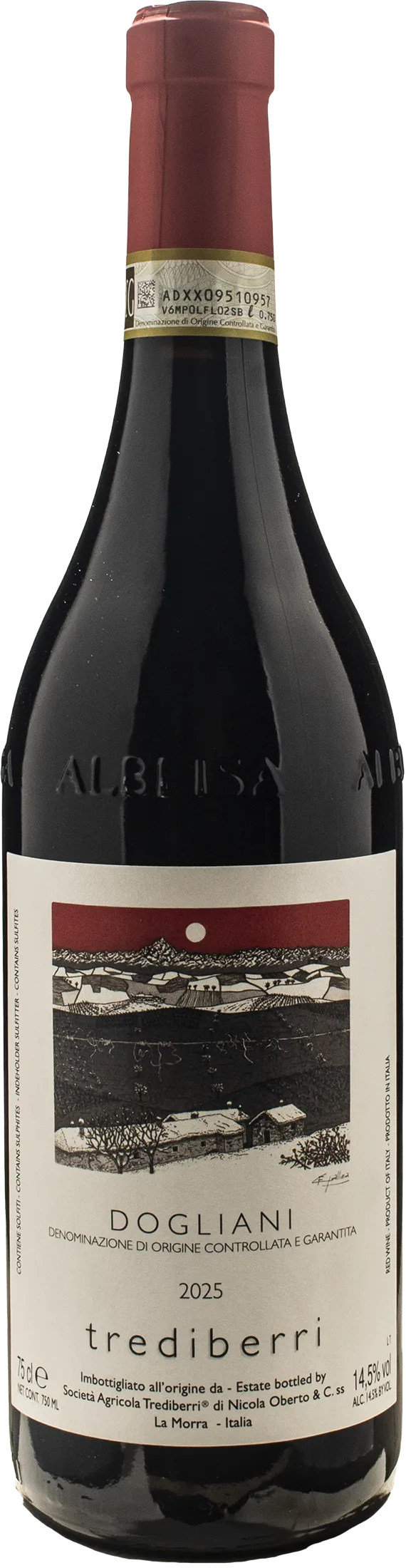
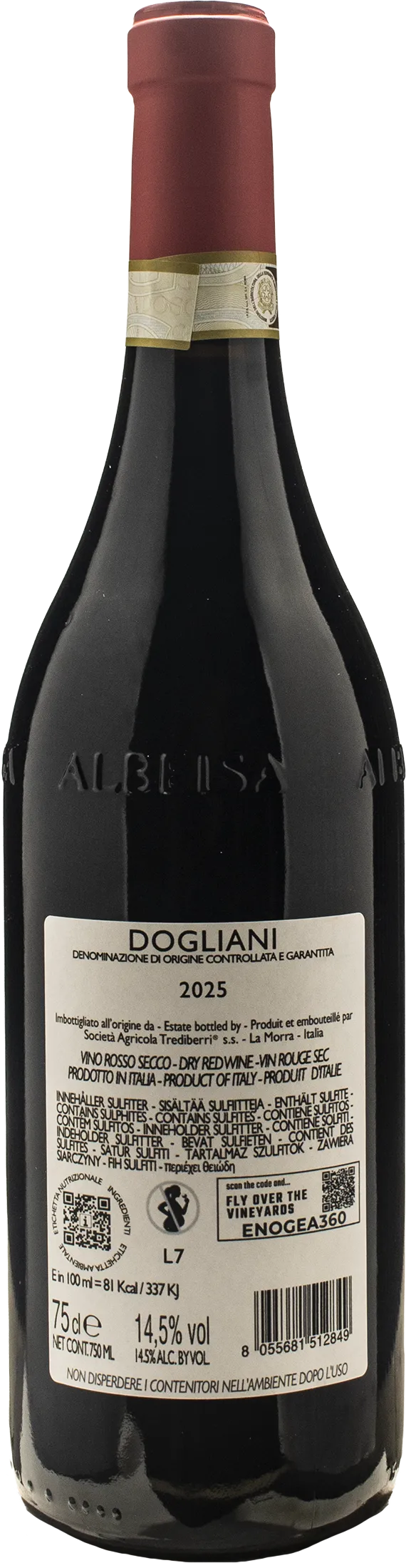
Dogliani 2025
| Denomination | DOCG Dogliani |
|---|---|
| Size | 0,75 l |
| Alcohol content | 14.5% by volume |
| Area | Piedmont (Italy) |
| Grape varieties | 100% Dolcetto |
| Aging | After stabilisation, the wine continues to mature for a few months in cement, steel or fibreglass, before bottling, usually between April and May of the year following the harvest. |
- Name and grape: Dogliani DOCG 2025, 100% Dolcetto, still red wine from Piedmont
- Tasting profile: black cherry and plum, delicate tannins, fresh, spicy and peppery finish
- Vinification: 10 days fermentation in concrete, malolactic fermentation in concrete or steel
- Serving: decant for 1 hour, serve at 14-16°C to enhance freshness
- Pairings: saffron risotto, spicy dishes, cured meats, soft cheeses, white fish
Description
What kind of wine it is
Dogliani by Trediberri is a still red wine from Piedmont with controlled and guaranteed designation of origin, an authentic expression of the Dolcetto grape variety. It stands out for its medium body and vinous profile, characterised by soft tannins, pronounced freshness, hints of black cherry and plum, and a delicate almond note typical of the variety. The palate finishes with a long, spicy finish, enriched by peppery nuances. Fermentation and ageing in concrete and steel give a bright, straightforward glass with great drinkability.
Where it comes from
This red originates in the Dogliani area. The grapes come from hillside vineyards located between the municipalities of Cigliè, Bastia Mondovì and Clavesana, as well as from the Berri Cru. Trediberri oversees every stage with a rigorous approach, aiming to enhance the pure varietal expression of Dolcetto through the combination of different plots. The result is a linear and precise wine, capable of elegantly and clearly conveying the Piedmontese soil.
How it is produced
Vinification begins with a fermentation in concrete lasting about ten days, an ideal choice to preserve the integrity of the fruit. Malolactic fermentation also takes place in neutral tanks, followed by cold stabilisation. Ageing continues in neutral containers, such as steel and concrete, to protect the vibrant energy of the raw material. This meticulous process gives the wine an immediate juiciness, making it perfect to accompany cheeses and spicy dishes.
History and Curiosities
The Dogliani 2025 by Trediberri expresses the authentic Piedmontese spirit, thanks to grapes grown between Cigliè, Bastia Mondovì and Clavesana. Founded in La Morra in 2011 by Federico Oberto, this artisan winery combines a connection with the vineyards of the Langhe with a contemporary oenological vision.
Tasting notes

Perfume

Color

Taste
Serve at:
14 -16 °C
Longevity:
05 - 10 years
Decanting time:
1 hour
- Start up year: 2011
- Oenologist: Federico Oberto
- Bottles produced: 120.000
- Hectares: 10
Our first wine was released in 2011 and today we vinify wine from 10,5 ha (26 acres) of vineyards: in addition to the original 5 ha (12 acres) in the Berri Cru, we also own 2,8 ha (7 acres) in the Crus of Rocche dell’Annunziata and Torriglione – where we grow Barolo, Barbera and Sauvignon Blanc – and we are currently renting 3 ha (7,5 acres) of Dolcetto and Nebbiolo in Bastia Mondovì and Clavesana, within the southern area of Langhe Region, at the feet of the Alps. From 2012 until 2017 included, we had the privilege to cultivate another hectare of Nebbiolo for Barolo in the Capalot Cru, in La Morra. Unluckily, from 2018 that contract hasn’t been renewed. We are a young, artisanal family winery.
We have no ancestral coat of arms depicting rampant horses and fluttering ensigns. We have no history and that is fine by us: we like talking about the present, through our wines. Read more


| Name | Trediberri Dogliani 2025 |
|---|---|
| Type | Red still |
| Denomination | Dogliani DOCG |
| Vintage | 2025 |
| Size | 0,75 l |
| Alcohol content | 14.5% by volume |
| Grape varieties | 100% Dolcetto |
| Country | Italy |
| Region | Piedmont |
| Vendor | Trediberri |
| Story | History and Curiosities The Dogliani 2025 by Trediberri expresses the authentic Piedmontese spirit, thanks to grapes grown between Cigliè, Bastia Mondovì and Clavesana. Founded in La Morra in 2011 by Federico Oberto, this artisan winery combines a connection with the vineyards of the Langhe with a contemporary oenological vision. |
| Origin | Cigliè, Bastia Mondovì and Clavesana |
| Fermentation | Approximately 10 days |
| Production technique | Alcoholic fermentation exclusively in concrete for about 10 days; malolactic fermentation in concrete or steel; cold stabilisation (outdoors or in temperature-controlled steel tanks); ageing for a few months in concrete, steel or fibreglass before bottling. |
| Wine making | Fermentation takes place exclusively in concrete for about 10 days; this is followed by malolactic fermentation in concrete or steel and cold stabilisation (either outdoors or in temperature-controlled steel tanks). The wine is then matured for several months in concrete, steel or fibreglass before bottling. |
| Aging | After stabilisation, the wine continues to mature for a few months in cement, steel or fibreglass, before bottling, usually between April and May of the year following the harvest. |
| Allergens | Contains sulphites |