


Cantina Tramin
Stoan Bianco 2024
| Denomination | DOC Alto Adige Bianco |
|---|---|
| Size | 0,75 l |
| Alcohol content | 13.5% by volume |
| Area | Trentino Alto Adige (Italy) |
| Grape varieties | 65% Chardonnay, 20% Sauvignon, 10% Pinot Bianco, 5% Traminer Aromatico |
| Aging | Maturation in large wooden casks (30–40 hl) on the lees until the end of August; after bottling, it rests in the bottle for at least 3 months, for a minimum total ageing period of 14 months. |
- Dry South Tyrolean blend: Chardonnay, Sauvignon, Pinot Blanc and Gewürztraminer grapes
- Hillside origin: Sella area of Termeno at 400–600 m, calcareous and gravelly soils
- Aromas: notes of peach, pear, pineapple, white flowers and a slight hint of tomato leaf
- Mineral and savoury flavour: lively freshness, creamy structure and a persistent, clean finish
- Wood ageing: fermentation at 18–20 °C, long period on the lees and 3 months in the bottle

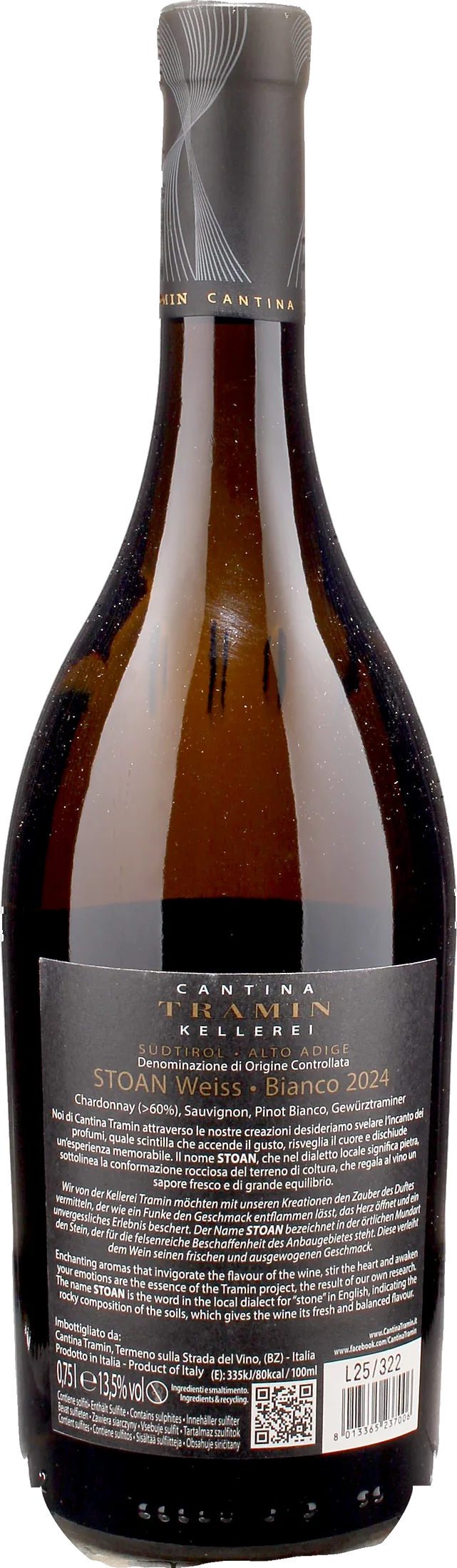
Description
What type of wine it is
Stoan from Cantina Tramin is a white wine from South Tyrol with a bold character, the result of a refined blend that combines Chardonnay, Sauvignon, Pinot Blanc and Gewürztraminer. It stands out for its dry and elegant style, characterised by a distinct mineral imprint and a vibrant freshness. On the nose, it reveals aromas of ripe fruit such as peach, pear and pineapple, enriched by notes of white flowers and subtle herbaceous nuances of tomato leaf. On the palate, it is savoury, balanced and persistent, with a pleasantly creamy texture. Maturation in large wooden barrels helps to give structure and complexity to the sip.
Where it comes from
The grapes come from the steep hillside vineyards located in Sella, a hamlet of Tramin in South Tyrol. The name Stoan recalls the local term for ‘stone’, a tribute to the calcareous and clayey soils rich in gravel that give the wine a marked salinity. The vineyards, facing south-east and situated between 400 and 600 metres above sea level, benefit from a unique microclimate. The strong temperature fluctuations between sunny days and nights cooled by Alpine winds favour optimal ripening of the grapes, ensuring balance and a precise aromatic definition.
How it is produced
Hand-harvesting ensures the integrity of the bunches, which are then sent for soft pressing. Slow fermentation takes place at a controlled temperature inside large wooden barrels, where the wine also undergoes malolactic fermentation. This is followed by prolonged ageing on the lees, also in wooden barrels, until the end of summer, while clarification takes place by natural sedimentation. This process gives a smooth texture and remarkable persistence, defined by elegant saline notes and a pleasant creamy component.
History and facts
Founded in 1898 to protect mountain winegrowers, Cantina Tramin embodies the purest oenological essence of South Tyrol. The name of this prestigious white cuvée derives from ‘Stoan’, a term in the Termeno dialect meaning stone, in tribute to the limestone and gravelly soils situated between 400 and 600 metres above sea level. This deep territorial vocation infuses the wine with a vibrant minerality, confirming an absolute excellence praised by critics and evidenced by the 93 points awarded to the 2023 vintage by James Suckling.
Tasting notes

Perfume

Color

Taste
Serve at:
12 - 14 °C
Longevity:
05 - 10 years
Decanting time:
1 hour

- Start up year: 1898
- Oenologist: Willi Stürz
- Bottles produced: 1.900.000
- Hectares: 270
Today, we are 160 families tending approximately 270 hectares of vineyards. We pride ourselves on the fact that each bottle is the quintessence of our philosophy of life and work: accuracy, commitment, trust and creativity. Read more


| Name | Tramin Stoan Bianco 2024 |
|---|---|
| Type | White still |
| Denomination | Alto Adige DOC |
| Vintage | 2024 |
| Size | 0,75 l |
| Alcohol content | 13.5% by volume |
| Grape varieties | 65% Chardonnay, 20% Sauvignon, 10% Pinot Bianco, 5% Traminer Aromatico |
| Country | Italy |
| Region | Trentino Alto Adige |
| Vendor | Cantina Tramin |
| Story | History and facts Founded in 1898 to protect mountain winegrowers, Cantina Tramin embodies the purest oenological essence of South Tyrol. The name of this prestigious white cuvée derives from ‘Stoan’, a term in the Termeno dialect meaning stone, in tribute to the limestone and gravelly soils situated between 400 and 600 metres above sea level. This deep territorial vocation infuses the wine with a vibrant minerality, confirming an absolute excellence praised by critics and evidenced by the 93 points awarded to the 2023 vintage by James Suckling. |
| Origin | Sella, a hamlet of Termeno (Tramin), South Tyrol (Trentino-South Tyrol), Italy |
| Climate | Cool climate with a high diurnal temperature range: warm days influenced by the Mediterranean and cool nights refreshed by Alpine winds. |
| Soil composition | Gravel, limestone and clay, mineral |
| Yield per hectare | 50 hectolitres per hectare |
| Harvest | End of September |
| Fermentation temperature | 18 to 20 °C |
| Production technique | Manual harvest; immediate pressing; slow fermentation at a controlled temperature (18–20 °C) in large wooden barrels (30–40 hl) with malolactic fermentation; racking and transfer by natural sedimentation; long ageing on the lees in barrels until the end of August; bottle ageing for at least 3 months |
| Wine making | Grapes hand-harvested and placed in small crates; immediate pressing; slow fermentation at a controlled temperature (18–20 °C) in large wooden casks (30–40 hl) with malolactic fermentation; racking of the must by natural sedimentation; long ageing on the lees in the same casks until late August, followed by bottle ageing for at least 3 months. |
| Aging | Maturation in large wooden casks (30–40 hl) on the lees until the end of August; after bottling, it rests in the bottle for at least 3 months, for a minimum total ageing period of 14 months. |
| Total acidity | 5.9 gr/L |
| Residual sugar | 2.9 gr/L |
| Allergens | Contains sulphites |