


Tiefenbrunner
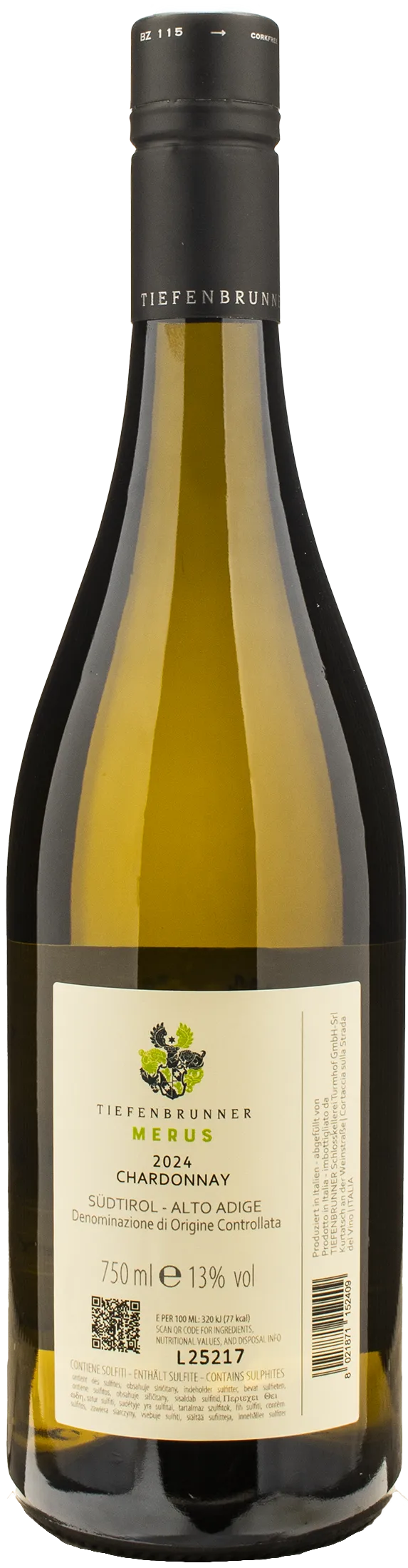
Merus Chardonnay 2024
Other years:
2025| Denomination | DOC Alto Adige Chardonnay |
|---|---|
| Size | 0,75 l |
| Alcohol content | 13.0% by volume |
| Area | Trentino Alto Adige (Italy) |
| Grape varieties | 100% Chardonnay |
| Aging | Aged for four months on fine lees until bottling |
| Other years | 2025 |
- Identity: Still white wine Alto Adige DOC, 100% Chardonnay, 2024, 0.75 l
- Vinification: Fermentation in cement tanks and ageing for 4 months on the lees
- Aromatic profile: Wildflowers, pineapple and exotic fruit with spicy notes
- Taste: Freshness, slight savouriness and good structure, full-bodied sip and persistent finish
- Pairings: Ideal with fish, seafood, risottos, white meats and gnocchi

Description
What kind of wine it is
Tiefenbrunner's Chardonnay Merus precisely embodies the character of South Tyrol. In the glass, it displays a brilliant pale yellow colour, enhanced by elegant green highlights. The bouquet is typical for Chardonnay, with delicate notes of wildflowers interwoven with aromas of exotic fruit, particularly pineapple, and spicy hints. On the palate, it reveals a young and fresh style, supported by a well-structured body. The savoury vein enhances a full and persistent sip, making it ideal to pair with fish dishes, white meats, and cheese gnocchi.
Where it comes from
The grapes are grown in South Tyrol, cultivated by Tiefenbrunner between Cortaccia and the Magrè plain, at an altitude between 210 and 400 metres. In Cortaccia, the soils are characterised by calcareous gravel of morainic origin, while in Magrè, sandy alluvial soils prevail. This variety of soil types encourages the balanced development of the Chardonnay clusters, trained using the traditional pergola and espalier systems, which give the wine a natural freshness and well-defined savouriness.
How it is produced
The winemaking process aims to preserve the aromatic integrity of the fruit. Fermentation takes place at a controlled temperature in concrete vats for about ten days, ensuring precise extraction. This is followed by careful ageing on fine lees for four months. This maturation period enhances the structure and smoothness of the wine, adding complexity without compromising its pleasant immediacy. The result is a harmonious white that faithfully expresses the characteristics of the grape variety.
History and Curiosities
The Merus Chardonnay celebrates the true vocation of the Tiefenbrunner family, master winemakers in South Tyrol since 1848. The fine grapes come from the hillside vineyards of Cortaccia and the plain of Magrè, before fermenting in cement tanks. Thanks to four months of ageing on the fine lees, this refined DOC white acquires an elegant structure and a velvety sip. In the glass, it releases floral scents that fade into sweet aromas of exotic fruit, offering the palate a pleasant savouriness and a finish of extraordinary persistence.
Tasting notes
Perfume

Color
Taste
Serve at:
10 - 12 °C
Longevity:
03 - 05 years
- Start up year: 1848
- Oenologist: Stephan Rohregger
- Bottles produced: 650.000
- Hectares: 88
It is both an honor and a responsibility to carry on the legacy and to continue writing the story of the Tiefenbrunner family, chapter by chapter, year after year, vintage after vintage. Read more


| Name | Tiefenbrunner Merus Chardonnay 2024 |
|---|---|
| Type | White still |
| Denomination | Alto Adige DOC |
| Vintage | 2024 |
| Size | 0,75 l |
| Alcohol content | 13.0% by volume |
| Grape varieties | 100% Chardonnay |
| Country | Italy |
| Region | Trentino Alto Adige |
| Vendor | Tiefenbrunner |
| Story | History and Curiosities The Merus Chardonnay celebrates the true vocation of the Tiefenbrunner family, master winemakers in South Tyrol since 1848. The fine grapes come from the hillside vineyards of Cortaccia and the plain of Magrè, before fermenting in cement tanks. Thanks to four months of ageing on the fine lees, this refined DOC white acquires an elegant structure and a velvety sip. In the glass, it releases floral scents that fade into sweet aromas of exotic fruit, offering the palate a pleasant savouriness and a finish of extraordinary persistence. |
| Origin | Cortaccia e Magrè |
| Soil composition | Calcareous gravel from morainic sediments in Cortaccia; sandy alluvial soils in Magrè |
| Cultivation system | Pergola and espalier |
| Plants per hectare | 3500-7000 |
| Yield per hectare | 65-75 hl/ha |
| Fermentation temperature | 20 °C |
| Fermentation | 10 days |
| Production technique | Temperature-controlled fermentation in concrete tanks; ageing for four months on fine lees |
| Wine making | Temperature-controlled fermentation (20 °C) for 10 days in concrete tanks, followed by ageing for four months on fine lees until bottling. |
| Aging | Aged for four months on fine lees until bottling |
| Total acidity | 6.2 gr/L |
| Residual sugar | 2.4 gr/L |
| Allergens | Contains sulphites |