


Tenuta San Guido
Guidalberto 2023
| Denomination | IGT Toscana |
|---|---|
| Size | 0,75 l |
| Alcohol content | 13.5% by volume |
| Area | Tuscany (Italy) |
| Grape varieties | 60% Cabernet Sauvignon, 40% Merlot |
| Aging | Malolactic fermentation carried out in stainless steel vats, then aged for 15 months in French oak barriques and partly in American oak. |
- Name and vintage: Toscana IGT still red, Guidalberto 2023, 0.75 l, 13.5% vol
- Grape variety: 60% Cabernet Sauvignon and 40% Merlot from Bolgheri, Castagneto Carducci
- Aroma: Notes of wild berries, delicate spices, Mediterranean scrub, mocha and nutmeg
- Taste: Elegant and sweet tannins, balanced acidity and savoury minerality, persistent finish
- Production and serving: Aged 15 months in barrique; serving temperature 14–16 °C
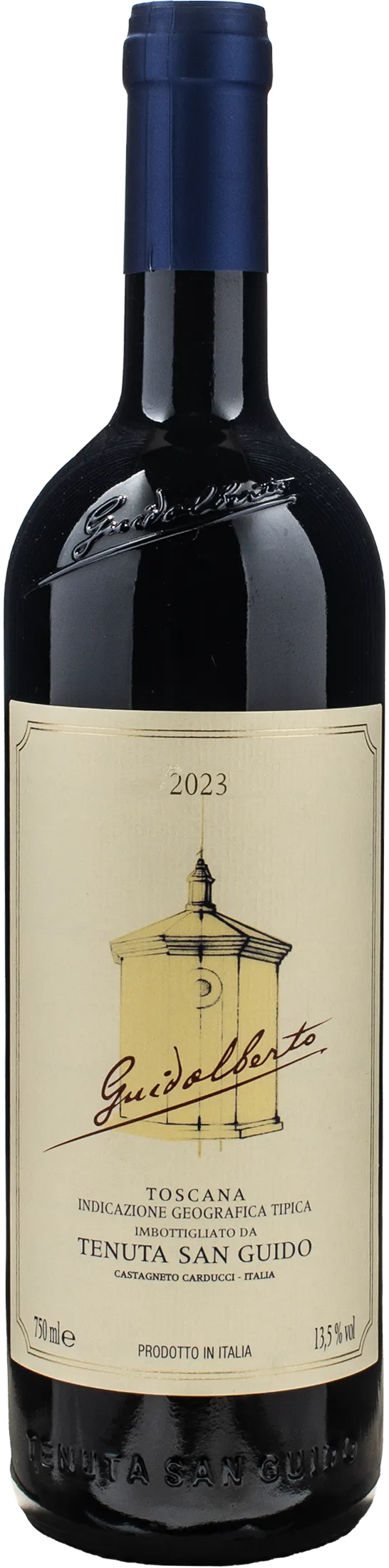

Description
What kind of wine it is
Guidalberto is an elegant still red wine from Tenuta San Guido, the result of a balanced blend of Cabernet Sauvignon and Merlot. A true expression of Tuscany, it combines impeccable technical precision with a profound structure. On the nose, it reveals enveloping aromas of wild berries, Mediterranean scrub, mocha and nutmeg. On the palate, it stands out for its refined and velvety tannins, supported by harmonious acidity and a vibrant savoury minerality that leads to a long and complex finish.
Where it comes from
The grapes grow in the Bolgheri area, near Castagneto Carducci, in a region of Tuscany with an extraordinary winemaking tradition. The vineyards are situated between one hundred and three hundred metres above sea level, with a south and south-west exposure that ensures optimal aromatic ripening. The terroir is characterised by limestone and clay soils, rich in marl and stones, essential for giving the wine its distinctive mineral note. The name Guidalberto pays tribute to an ancestor of the Incisa della Rocchetta family, celebrating the historic connection with the estate.
How it is produced
The production process begins with a rigorous manual harvest, carried out between the end of August and September to respect the ripening times of each grape variety. After careful selection and gentle pressing, fermentation takes place in stainless steel tanks at a controlled temperature with indigenous yeasts. Extraction is managed through careful pumping over and délestage. Following malolactic fermentation, the wine acquires its final structure thanks to ageing in French and American oak barrels for fifteen months, thus completing its enveloping aromatic complexity.
History and Curiosities
Born in Bolgheri in honour of the ancestor of the Incisa della Rocchetta family, this Tuscan IGT red anticipates the elegance of its famous elder brother, Sassicaia. Created by Tenuta San Guido, it is made from a blend of Cabernet Sauvignon and Merlot and matures for fifteen months in oak barriques. An outstanding wine capable of enchanting with its savoury minerality and hints of Mediterranean scrub, it was awarded the extraordinary score of 96/100 by James Suckling.
Awards
-
2023
 5
5Italian Sommelier Foundation (FIS) guide This has been one of the most prestigious wine guides in Italy for over 10 years.
-
2023
 96
96/100
James Suckling is an influential American wine critic and journalist who worked at Wine Spectator for 30 years. He left the magazine in 2010 to start his own website and guidebook (JamesSuckling.com). He specialises in Italian and Bordeaux wines.
-
2023
 92
92/100
Vinous is the online guide from Antonio Galloni, one of the world's leading wine connoisseurs.
Tasting notes

Perfume

Color

Taste
Serve at:
14 -16 °C
Longevity:
10 - 15 years
Decanting time:
1 hour
- Start up year: 1940
- Oenologist: Nicolò Incisa della Rocchetta, Carlo Paoli, Graziana Grassini
- Bottles produced: 980.000
- Hectares: 90


| Name | Tenuta San Guido Guidalberto 2023 |
|---|---|
| Type | Red still |
| Denomination | Toscana IGT |
| Vintage | 2023 |
| Size | 0,75 l |
| Alcohol content | 13.5% by volume |
| Grape varieties | 60% Cabernet Sauvignon, 40% Merlot |
| Country | Italy |
| Region | Tuscany |
| Vendor | Tenuta San Guido |
| Story | History and Curiosities Born in Bolgheri in honour of the ancestor of the Incisa della Rocchetta family, this Tuscan IGT red anticipates the elegance of its famous elder brother, Sassicaia. Created by Tenuta San Guido, it is made from a blend of Cabernet Sauvignon and Merlot and matures for fifteen months in oak barriques. An outstanding wine capable of enchanting with its savoury minerality and hints of Mediterranean scrub, it was awarded the extraordinary score of 96/100 by James Suckling. |
| Origin | Bolgheri, Castagneto Carducci (LI) |
| Soil composition | Various and composite morphological characteristics, with a strong presence of calcareous areas rich in galestro and stones, partly clayey. |
| Cultivation system | Spurred cordon |
| Plants per hectare | 6250 |
| Harvest | End of August (Merlot) and from September (Cabernet Sauvignon) |
| Fermentation temperature | 26–28 °C |
| Production technique | Manual sorting and selection of bunches and berries; destemming and soft pressing; alcoholic fermentation in stainless steel vats at a controlled temperature (26–28 °C) with indigenous yeasts; maceration; pumping over and delestage; malolactic fermentation in stainless steel; ageing for 15 months in French oak barriques and a small part in American oak |
| Wine making | Careful sorting and selection of bunches and berries by hand using a sorting table; gentle pressing and destemming to avoid breaking the berries and excessive release of tannins. Alcoholic fermentation in stainless steel vats at controlled temperature (26–28 °C) without the addition of external yeasts; maceration for about 12–15 days for Merlot and 10–13 days for Cabernet Sauvignon. Frequent pumping over and délestage to enhance the aromatic expression of the musts; malolactic fermentation carried out in steel and subsequent ageing for 15 months in French oak barriques with a small proportion of American oak. |
| Aging | Malolactic fermentation carried out in stainless steel vats, then aged for 15 months in French oak barriques and partly in American oak. |
| Allergens | Contains sulphites |