


San Polo Azienda Agricola (Allegrini)
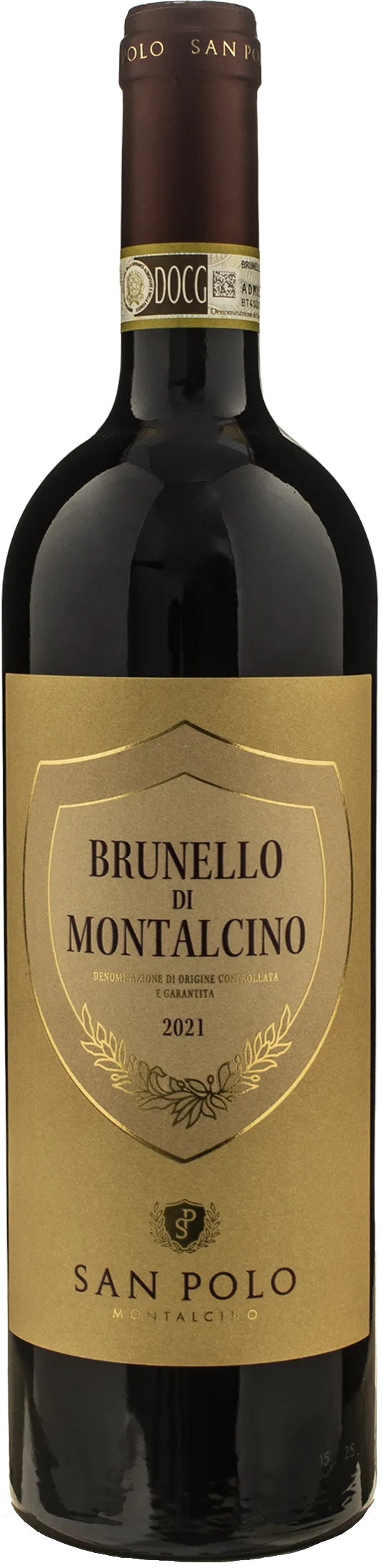
Brunello di Montalcino 2021
Other years:
2018| Denomination | DOCG Brunello di Montalcino |
|---|---|
| Size | 0,75 l |
| Alcohol content | 14.5% by volume |
| Area | Tuscany (Italy) |
| Grape varieties | 100% Sangiovese |
| Aging | 24 months in 500-litre French oak tonneaux with medium toasting (partly new and partly second use), followed by at least 6 months of bottle ageing |
| Other years | 2018 |
- Name and grape: Organic Brunello di Montalcino DOCG, 100% Sangiovese
- Vintage and format: 2021, 0.75 litre bottle, 14.5% alcohol
- Vinification: hand-picked, fermented in concrete at 28-30°C for 20-22 days
- Ageing: 24 months in 500-litre French oak tonneaux and at least 6 months in bottle
- Sensory profile: hints of violet and red fruits, notes of coffee, full-bodied with pronounced tannins

Description
What kind of wine it is
The Brunello di Montalcino from San Polo is a structured red wine made from Sangiovese grapes grown organically. On the nose, it expresses aromas of violet and small red fruits, enriched by hints of undergrowth and aromatic wood. On the palate, it reveals a dense texture and well-defined tannins, while the aromatic evolution offers nuances of vanilla and persistent notes of coffee, for an enveloping and profound sip.
Where it comes from
It comes from the Podernovi area in Montalcino, from vineyards located at 450 metres above sea level with a south and south-west exposure. The area is characterised by soils rich in clay and calcium, ideal for providing structure and promoting optimal ripening of the grapes. The management of the sixteen hectares of vineyards follows the principles of organic farming, a commitment to sustainability that has enabled the winery to obtain the CasaClima Wine certification.
How it is produced
The manual harvest takes place at the end of September, with a rigorous selection of the bunches and gentle pressing. Fermentation takes place in cement vats at a controlled temperature for about twenty days. Subsequently, the wine undergoes malolactic fermentation and matures for twenty-four months in medium-toast French oak barrels, partly new and partly second passage. A rest in the bottle for at least six months completes the process.
History and Curiosities
Founded in 1990 on the magnificent Podernovi estate in Montalcino, the San Polo winery stands out for the elegance of its organic Brunello di Montalcino DOCG. Led by the Allegrini family and oenologist Riccardo Fratton, it was the first Tuscan winery to be awarded the CasaClima Wine certification. This genuine commitment to environmental sustainability finds its highest expression in the memorable 2019 vintage, rated 95 points by James Suckling and Wine Spectator and perfected by rigorous bottle ageing.
Awards
-
2021
 2
2This guide is highly respected and offers the most comprehensive review of Italian wines. It has a long tradition and is based on blind tastings carried out by over 100 experts.
-
2021
 95
95/100
James Suckling is an influential American wine critic and journalist who worked at Wine Spectator for 30 years. He left the magazine in 2010 to start his own website and guidebook (JamesSuckling.com). He specialises in Italian and Bordeaux wines.
-
2021
 3
3Italian Sommelier Association (AIS) guide
Tasting notes

Perfume

Color

Taste
Serve at:
18 - 20 °C
Longevity:
10 - 15 years
Decanting time:
1 hour
- Start up year: 1990
- Oenologist: Riccardo Fratton
- Bottles produced: 160.000
- Hectares: 16
Our goal was to transform the San Polo Estate into a premium quality winery. The year 2007 marked the beginning of a new era for San Polo: a prestigious, historic appellation was accompanied by an entrepreneurial approach and openness to multiple business opportunities. Subsequently, the importance of an eco-friendly approach was understood and developed, leading to a steadfast commitment to sustainability, which is now the hallmark of the Estate and pervades and informs all its practices and operations.
San Polo is situated in Podernovi, on the southern slope of Montalcino. The valley is called Sant’ Antimo and there too, almost at touching distance, stands Mount Amiata. The locals call this area a ‘Mezzopane’, meaning that to admire the beautiful view is to ‘take one’s fill’, like food for the soul. The windows, knolls and vantage points of the Estate’s two farmhouses look out over the breath-taking Tuscan landscape of the Old Masters. And finally, San Polo’s modern and innovative wine-making cellar, so cutting-edge as to have become synonymous with the Company itself.
First winery in Tuscany to be certified CasaClima Wine. Read more


| Name | San Polo Brunello di Montalcino 2021 |
|---|---|
| Type | Red organic still |
| Denomination | Brunello di Montalcino DOCG |
| Vintage | 2021 |
| Size | 0,75 l |
| Alcohol content | 14.5% by volume |
| Grape varieties | 100% Sangiovese |
| Country | Italy |
| Region | Tuscany |
| Vendor | San Polo Azienda Agricola (Allegrini) |
| Story | History and Curiosities Founded in 1990 on the magnificent Podernovi estate in Montalcino, the San Polo winery stands out for the elegance of its organic Brunello di Montalcino DOCG. Led by the Allegrini family and oenologist Riccardo Fratton, it was the first Tuscan winery to be awarded the CasaClima Wine certification. This genuine commitment to environmental sustainability finds its highest expression in the memorable 2019 vintage, rated 95 points by James Suckling and Wine Spectator and perfected by rigorous bottle ageing. |
| Origin | Località Podernovi, Montalcino (SI), Tuscany, Italy |
| Climate | Altitude 450 m a.s.l.; south and south-west exposure |
| Soil composition | Rich in calcium and clay |
| Cultivation system | Spurred cordon |
| Plants per hectare | 4000-7000 |
| Yield per hectare | 34 hl/ha |
| Harvest | Late September |
| Fermentation temperature | 28-30 °C |
| Fermentation | 20-22 days |
| Production technique | Manual harvest in crates; soft pressing; fermentation in concrete tanks; malolactic fermentation in 500-litre tonneaux; ageing for 24 months in medium-toast French oak tonneaux and at least 6 months in bottle |
| Wine making | Manual harvest in 17 kg crates at the end of September with grape selection and gentle pressing; fermentation in cement vats at 28–30 °C for 20–22 days; malolactic fermentation in 500-litre tonneaux; ageing for 24 months in medium-toast French oak tonneaux (partly new and partly second use) and at least 6 months in bottle. |
| Aging | 24 months in 500-litre French oak tonneaux with medium toasting (partly new and partly second use), followed by at least 6 months of bottle ageing |
| Total acidity | 6.1 gr/L |
| PH | 3.49 |
| Residual sugar | 0.5 gr/L |
| Dry extract | 31.4 gr/L |
| Year production | 160000 bottles |
| Allergens | Contains sulphites |