


Querciabella
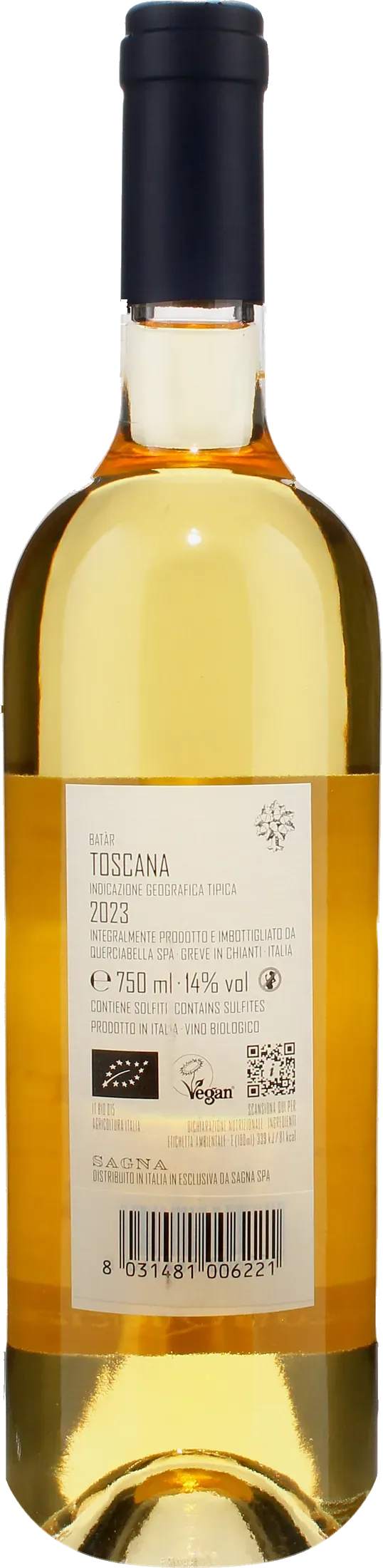
Batar 2023
| Denomination | IGT Toscana |
|---|---|
| Size | 0,75 l |
| Alcohol content | 14.0% by volume |
| Area | Tuscany (Italy) |
| Grape varieties | 50% Chardonnay, 50% Pinot Bianco |
| Aging | Aged in French oak barriques for 9–12 months (Tronçais, Vosges and Allier forests; partly new), followed by approximately 6 months of bottle ageing before release; matured on the fine lees with weekly bâtonnage. |
- Type and grapes: Tuscan organic vegan white from Chardonnay and Pinot Blanc grapes.
- Aromatic profile: notes of honey, wheat, broom and plum; finishes with hints of saffron.
- Taste and structure: savouriness, freshness and creaminess; echoes of pear, almond and ginger.
- Origin and soils: Ruffoli in Greve in Chianti; galestro, clay, schist and sandstone soils.
- Vinification and ageing: manual harvest; maturation for 9-12 months in oak, 6 in the bottle.

Description
Wine type
Batàr Querciabella is a Tuscan IGT white wine, organic and vegan, the result of an elegant blend of Chardonnay and Pinot Bianco. Fermented and aged in French oak barrels, this wine is distinguished by a broad and complex structure, balanced by a vibrant freshness and a marked savouriness that coats the palate with a clear creamy texture. The aromatic profile opens with notes of freshly mown wheat, propolis, honey and broom flowers, enriched by hints of yellow plum and quince jam. The long finish offers elegant spicy nuances of saffron.
Provenance
The grapes come from high-altitude vineyards located on the Ruffoli ridge in Greve in Chianti. The exposure is meticulously studied: the south-facing slopes host the Chardonnay, while the cooler plots to the north, near the cellar, are dedicated to Pinot Bianco. The soils present a rich geological variety with a predominance of galestro, combined with clay and schist in the northern areas and sandstone at higher altitudes. This precise mapping, managed according to a rigorous biodynamic agricultural approach, gives the wine a deep mineral complexity.
Production process
The hand-picked grapes undergo a gentle pressing to slowly extract the juice. Alcoholic fermentation and complete malolactic fermentation take place in barrels. The wine rests on the fine lees with weekly bâtonnage, gaining volume and texture. Ageing continues for between nine and twelve months in French oak barrels, partly new, originating from Tronçais, Vosges and Allier. Finally, six months of bottle ageing harmonises the wine's structural profile.
History and Curiosities
Originally born as Bâtard-Pinot, the iconic Batàr di Querciabella took on its current name in 1995 to distinguish itself from the classic wines of Burgundy and celebrate the union between Chardonnay and Pinot Bianco. This multi-award-winning Tuscan champion embodies a pioneering vision, founded on organic and biodynamic cultivation introduced as far back as 1988. Since 2010, ageing in new wood has been masterfully reduced to enhance its vibrant freshness. The designer label is signed by Bernardino Luino, for a wine acclaimed with 94 points.
Awards
-
2023
 94
94/100
James Suckling is an influential American wine critic and journalist who worked at Wine Spectator for 30 years. He left the magazine in 2010 to start his own website and guidebook (JamesSuckling.com). He specialises in Italian and Bordeaux wines.
-
2023
 94
94/100
Vinous is the online guide from Antonio Galloni, one of the world's leading wine connoisseurs.
Tasting notes
Perfume
Color
Taste
Serve at:
12 - 14 °C
Longevity:
05 - 10 years
- Start up year: 1974
- Oenologist: Manfred Ing
- Bottles produced: 380.000
- Hectares: 90
Mongrana, a blend of Sangiovese, Merlot and Cabernet Sauvignon, was the first wine to be released from the Alberese Querciabella estate (Maremma). Querciabella plans to introduce more wines from this region soon. Read more


| Name | Querciabella Batar 2023 |
|---|---|
| Type | White organic still |
| Denomination | Toscana IGT |
| Vintage | 2023 |
| Size | 0,75 l |
| Alcohol content | 14.0% by volume |
| Grape varieties | 50% Chardonnay, 50% Pinot Bianco |
| Country | Italy |
| Region | Tuscany |
| Vendor | Querciabella |
| Story | History and Curiosities Originally born as Bâtard-Pinot, the iconic Batàr di Querciabella took on its current name in 1995 to distinguish itself from the classic wines of Burgundy and celebrate the union between Chardonnay and Pinot Bianco. This multi-award-winning Tuscan champion embodies a pioneering vision, founded on organic and biodynamic cultivation introduced as far back as 1988. Since 2010, ageing in new wood has been masterfully reduced to enhance its vibrant freshness. The designer label is signed by Bernardino Luino, for a wine acclaimed with 94 points. |
| Origin | Ruffoli Ridge, Greve in Chianti (Florence), Tuscany |
| Soil composition | Galestro; presence of sandstone in the higher sites; clay and schist in the cooler north-facing plots |
| Yield per hectare | 25 hectolitres per hectare |
| Production technique | Manual harvesting; slow and gentle pressing; complete alcoholic and malolactic fermentation in oak barriques; maturation on fine lees with weekly bâtonnage; ageing for 9–12 months in French oak barriques (partly new); rested in the bottle for approximately 6 months. |
| Wine making | Manual harvest; slow and gentle juice extraction via pressing; fermentation (full alcoholic and malolactic) in oak barriques; maturation on the fine lees with weekly bâtonnage; ageing for 9–12 months in French oak barriques (Tronçais, Vosges and Allier, partly new), followed by resting in the bottle for approximately 6 months prior to commercialisation. |
| Aging | Aged in French oak barriques for 9–12 months (Tronçais, Vosges and Allier forests; partly new), followed by approximately 6 months of bottle ageing before release; matured on the fine lees with weekly bâtonnage. |
| Allergens | Contains sulphites |