


Prunotto
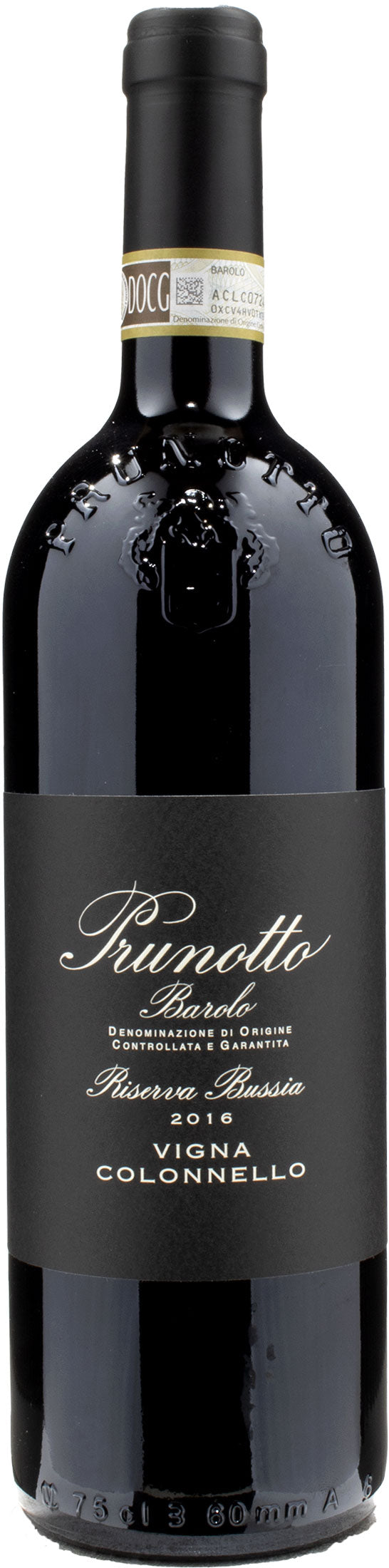
Barolo Bussia Vigna Colonnello Riserva 2016
Other years:
2019| Denomination | DOCG Barolo Riserva |
|---|---|
| Size | 0,75 l |
| Alcohol content | 14.5% by volume |
| Area | Piedmont (Italy) |
| Grape varieties | 100% Nebbiolo |
| Aging | Maturation took place in French oak of various capacities for 18 months and, subsequently, for 24 months in stainless steel. The wine was aged for 24 months in the bottle before being released onto the market. |
| Other years | 2019 |
- Designation: Barolo Bussia DOCG red wine from Nebbiolo grapes 2016
- Aroma: Notes of spices, flowers and forest floor; garnet ruby red colour
- Taste: Soft tannins, enveloping sip with long persistence on the palate
- Ageing: 18 months in oak, 24 in steel and 24 in bottle
- Service and details: 14.5% vol, 750 ml; decant for 1 hour, contains sulphites
Description
What type of wine it is
Prunotto's Barolo Bussia Vigna Colonnello Riserva is a still red wine with a Controlled and Guaranteed Designation of Origin (DOCG) made from Nebbiolo grapes, aged in oak barrels, which embodies the deep and structured style of the great Piedmontese reserves. To the eye, it presents a garnet ruby red colour, anticipating a complex bouquet characterised by notes of exotic spices, dried flowers and hints of forest floor. On the palate, it reveals an extraordinary taste concentration, supported by fine, sweet tannins that are enveloping and silky. The sip concludes with a long and persistent finish.
Where it comes from
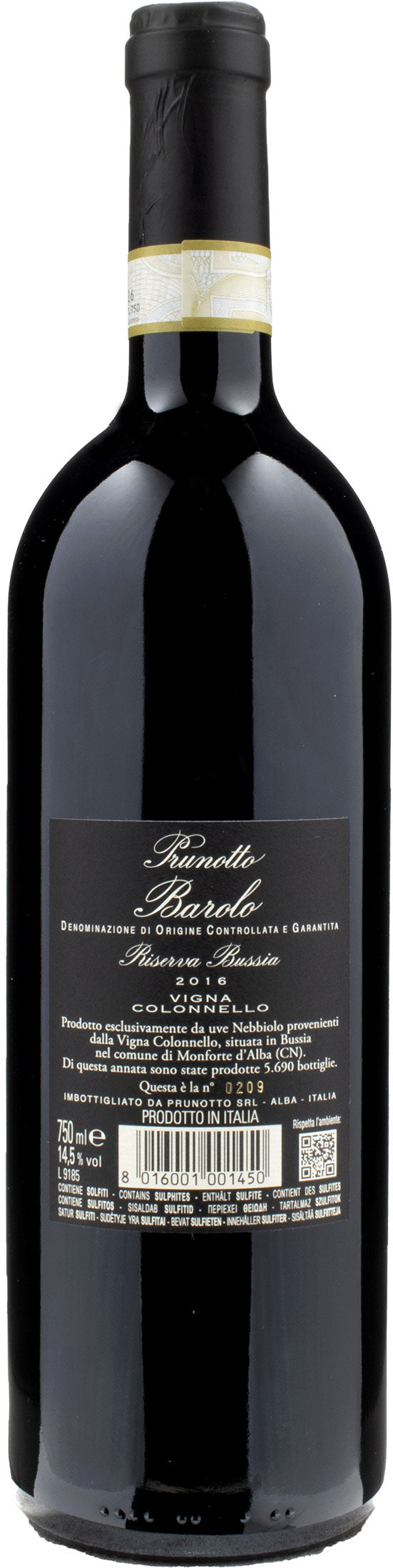
This wine is born in the heart of the Barolo area, specifically in the Bussia cru in Monforte d’Alba, Piedmont. The grapes come from a single hectare, the Colonnello Vineyard, which enjoys an ideal west and south-west exposure. The identity of this territory is sculpted by its particular geological composition: a harmonious encounter between Tortonian soil, which gives finesse and aromatic elegance, and Serravallian soil, which provides structure and power. This synergy between the different subsoil matrices gives the wine a territorial profile of exceptional depth.
How it is produced
Production begins with the crushing of the grapes and partial de-stemming, followed by maceration in temperature-controlled steel tanks for about seven days. After malolactic fermentation, which concludes before the end of winter, the wine embarks on a long ageing process. Maturation begins with eighteen months of resting in French oak barrels, fundamental for aromatic balance. Subsequently, the wine stays for twenty-four months in stainless steel to preserve the purity of the fruit, completing its cycle with a further bottle ageing of two years before being released onto the market.
History and Trivia
This prestigious Riserva originates from a single hectare located in the Bussia cru, in Monforte d’Alba, celebrating the perfect encounter between two exceptional terroirs. The gustatory harmony arises from the Tortonian soil, which bestows a rare elegance, combined with the extraordinary structure and power of the Serravallian terrain. The 2016 vintage of this Barolo Bussia DOCG has won over global critics, achieving ratings of absolute excellence from Robert Parker and James Suckling, as well as the highest accolades from Veronelli, Bibenda and Vinous.
Awards
-
2016
 5
5Italian Sommelier Foundation (FIS) guide This has been one of the most prestigious wine guides in Italy for over 10 years.
-
2016
 91
91/100
James Suckling is an influential American wine critic and journalist who worked at Wine Spectator for 30 years. He left the magazine in 2010 to start his own website and guidebook (JamesSuckling.com). He specialises in Italian and Bordeaux wines.
-
2016
 92
92/100
The prestigious international wine guide from the renowned Robert Parker, the world's most experienced and trusted wine taster.
-
2016
 3
3One of the most prestigious wine guides in Italy.
-
2016
 94
94/100
Vinous is the online guide from Antonio Galloni, one of the world's leading wine connoisseurs.
-
2016
 4
4Italian Sommelier Association (AIS) guide
-
2016
 92
92/100
Wine spectator is the most influential wine guide on the internet.
Tasting notes

Perfume

Color

Taste
Serve at:
18 - 20 °C
Longevity:
Over 25 years
Decanting time:
1 hour
- Start up year: 1904
- Oenologist: Gianluca Torrengo
- Bottles produced: 1.116.400
- Hectares: 70
The Antinori family, charmed by such rich natural beauty, unique vineyards and soils, decided to invest time and energy in this terroir confident that their efforts would make Prunotto what it is today, one of the most important winemaking estates in the Piedmont region. Read more


| Name | Prunotto Barolo Bussia Vigna Colonnello Riserva 2016 |
|---|---|
| Type | Red still |
| Denomination | Barolo DOCG |
| Vintage | 2016 |
| Size | 0,75 l |
| Alcohol content | 14.5% by volume |
| Grape varieties | 100% Nebbiolo |
| Country | Italy |
| Region | Piedmont |
| Vendor | Prunotto |
| Story | History and Trivia This prestigious Riserva originates from a single hectare located in the Bussia cru, in Monforte d’Alba, celebrating the perfect encounter between two exceptional terroirs. The gustatory harmony arises from the Tortonian soil, which bestows a rare elegance, combined with the extraordinary structure and power of the Serravallian terrain. The 2016 vintage of this Barolo Bussia DOCG has won over global critics, achieving ratings of absolute excellence from Robert Parker and James Suckling, as well as the highest accolades from Veronelli, Bibenda and Vinous. |
| Origin | Monforte d'Alba (Bussia), Piedmont, Italy |
| Soil composition | Tortonian soil and Serravallian terrain |
| Fermentation temperature | Maximum 30 °C |
| Fermentation | About 7 days |
| Production technique | Crushing with partial destemming (65%), maceration in stainless steel tanks for approximately 7 days (max 30 °C) with malolactic fermentation; maturation in French oak for 18 months, followed by 24 months in steel and ageing in the bottle for 24 months. |
| Wine making | Upon arrival at the winery, the grapes were crushed and only 65% were destemmed. Maceration, which took place in stainless steel tanks, lasted for approximately seven days at a maximum temperature of 30 °C. Malolactic fermentation was completed before the end of winter. |
| Aging | Maturation took place in French oak of various capacities for 18 months and, subsequently, for 24 months in stainless steel. The wine was aged for 24 months in the bottle before being released onto the market. |
| Allergens | Contains sulphites |