


Pojer e Sandri
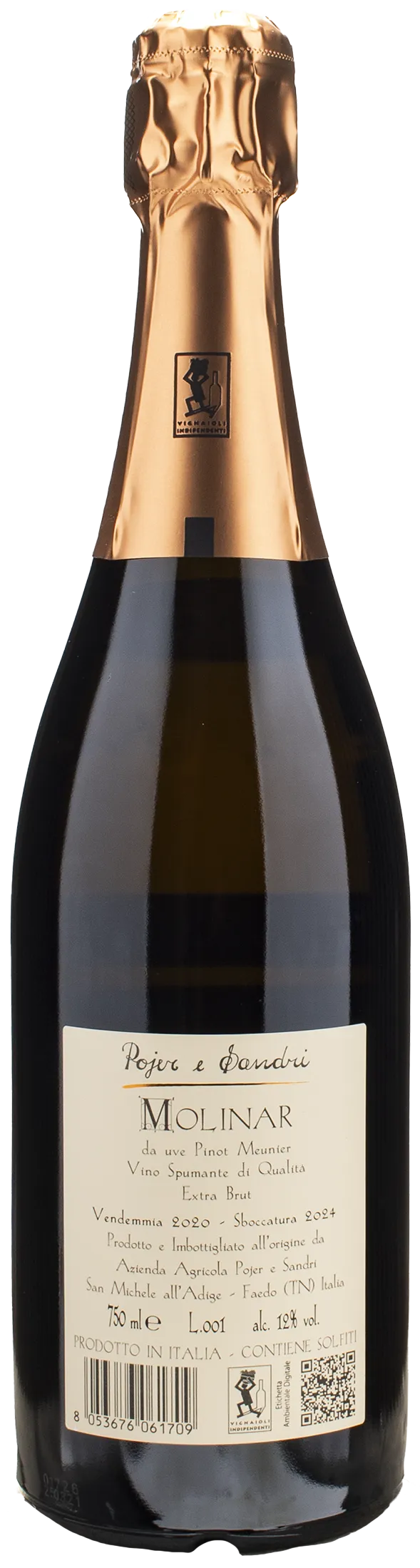
Molinar Extra Brut 2020
| Denomination | VSQ |
|---|---|
| Size | 0,75 l |
| Alcohol content | 12.0% by volume |
| Area | Trentino Alto Adige (Italy) |
| Grape varieties | 100% Pinot Meunier |
| Aging | In spring, the wine undergoes a second fermentation in the bottle and, after 36 months resting on the lees, disgorgement follows without the addition of sugars. |
- Metodo Classico Extra Brut: Rosé 2020, 12% vol, disgorged without added sugars
- Grapes and origin: 100% Pinot Meunier from Trentino Alto Adige, Molini area (Faedo)
- Ageing on the lees: Second fermentation in the bottle with 36 months maturation on the lees
- Sensory profile: Blush pink, notes of small red fruits; dry, savoury and persistent
- Serving and pairings: At 6-8 °C, ideal with aperitifs, fish, shellfish and white meats

Description
What kind of wine is it
Molinar Extra Brut is a rosé sparkling wine made using the Traditional Method by Pojer e Sandri. Made from Pinot Meunier grapes, it presents in the glass with an elegant powder pink colour. On the nose, it offers a rich and fragrant bouquet, characterised by clear notes of small red fruits. On the palate, it reveals a structure of great character, being completely dry and marked by a pronounced savoury note. Its long-lasting flavour makes it ideal for accompanying starters, shellfish, fish dishes, white meats and vegetarian recipes.
Where does it come from
The vineyards are located in Trentino Alto Adige, between San Michele all’Adige and Faedo, in the Molini area. The vines grow at an altitude of 550 metres, enjoying a north-west exposure. The soil is distinguished by a sedimentary matrix of marine origin, derived from the deposits of the Werfen strata. This land, with its distinctive silty-sandy texture, rests on a solid calcareous conglomerate composed of sandstones, siltstones, marls and dolomites. These mineral elements precisely define the aromatic profile of the grape and contribute to the distinct savoury tension that characterises every sip.
How is it produced
Vinification begins with manual harvesting, followed by cooling and careful washing of the bunches. After a brief maceration, pressing takes place in a controlled atmosphere to extract the colour and protect the integrity of the fruit. The first fermentation occurs in small barrels, placed on rotating supports and turned 180 degrees weekly using the hourglass technique, to optimise contact with the lees. In spring, the wine undergoes secondary fermentation in the bottle, as required by the Traditional Method, maturing on the lees for thirty-six months. The process concludes with disgorgement at zero dosage, with no added sugars.
History and Curiosities
Born in an ancient mill in Trentino, Molinar Extra Brut celebrates the origins of the Pojer e Sandri winery, founded in 1975. The name pays tribute to Pinot Meunier, the so-called “miller’s grape”, here exalted in a captivating Classic Method rosé. The 36 months of maturation on the lees and zero dosage disgorgement offer a dry and savoury sip, enriched by aromas of small fruits that enhance convivial moments with vibrant elegance.
Tasting notes

Perfume

Color

Taste
Serve at:
06 - 08 °C
Longevity:
05 - 10 years
- Start up year: 1975
- Oenologist: Mario Pojer
- Bottles produced: 250.000
- Hectares: 33
Faedo 1998: We are already starting to show our thirst for innovation: we are among the first at a national level to market Chardonnay, which until then was practically unknown.
Faedo 2002: We patent the reduction and press vinification with nitrogen recovery, which drastically reduces the use of sulphites. We then begin to wash the grapes through the grape jacuzzi.
The arrival of Marianna, Matteo, Fiamma, Elisa and Federico has brought further life and energy to this dream in which passion and innovation are the keystone.
Faedo 2013: The Zero Infinito project is born: Zero chemical treatments in the countryside, Zero sulphur dioxide, Zero commercial yeasts, Zero clarifying agents, Zero filtrations, Zero antioxidants. Read more


| Name | Pojer e Sandri Molinar Extra Brut 2020 |
|---|---|
| Type | Rosé green classic method sparkling wine extra brut |
| Denomination | VSQ |
| Vintage | 2020 |
| Size | 0,75 l |
| Alcohol content | 12.0% by volume |
| Grape varieties | 100% Pinot Meunier |
| Country | Italy |
| Region | Trentino Alto Adige |
| Vendor | Pojer e Sandri |
| Story | History and Curiosities Born in an ancient mill in Trentino, Molinar Extra Brut celebrates the origins of the Pojer e Sandri winery, founded in 1975. The name pays tribute to Pinot Meunier, the so-called "miller’s grape", here exalted in a captivating Classic Method rosé. The 36 months of maturation on the lees and zero dosage disgorgement offer a dry and savoury sip, enriched by aromas of small fruits that enhance convivial moments with vibrant elegance. |
| Origin | San Michele all'Adige - Faedo, località Molini |
| Climate | Altitude: 550 m a.s.l. with north-west exposure |
| Soil composition | Sedimentary of marine origin from Werfenian deposits of sandstones, siltstones, marls, limestones and dolomites; silty-sandy soil, with variable depth between 30 and 100 cm, resting on calcareous conglomerate |
| Cultivation system | Double arched Guyot |
| Plants per hectare | 6200 |
| Yield per hectare | 70-80 quintali per ettaro |
| Fermentation | 36 months on the lees |
| Production technique | Traditional method (second fermentation in bottle) |
| Wine making | Fermentation takes place in small barrels mounted on wheels; each week, using the hourglass technique, the barrel is rotated 180° to maximise contact between the lees and the wine. |
| Aging | In spring, the wine undergoes a second fermentation in the bottle and, after 36 months resting on the lees, disgorgement follows without the addition of sugars. |
| Allergens | Contains sulphites |