


Pieropan
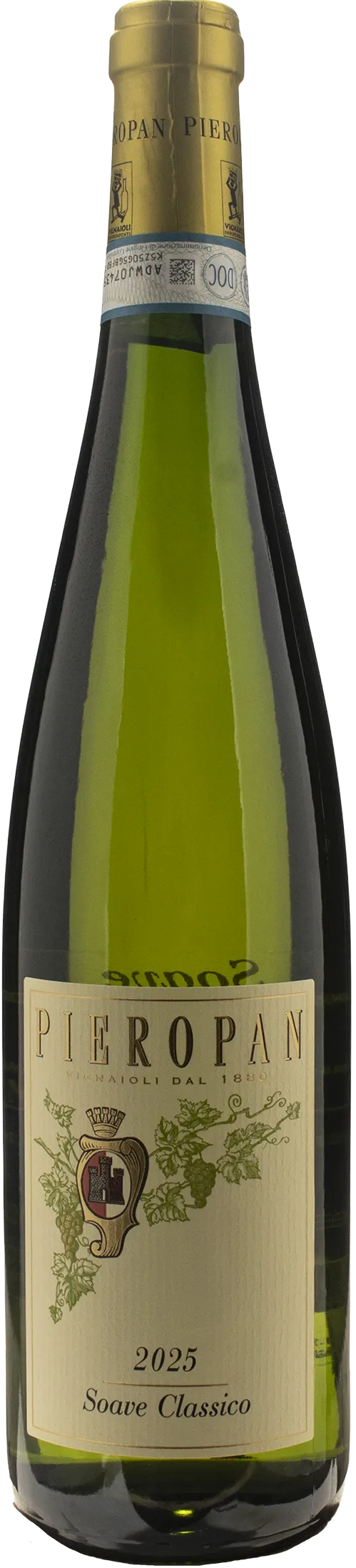
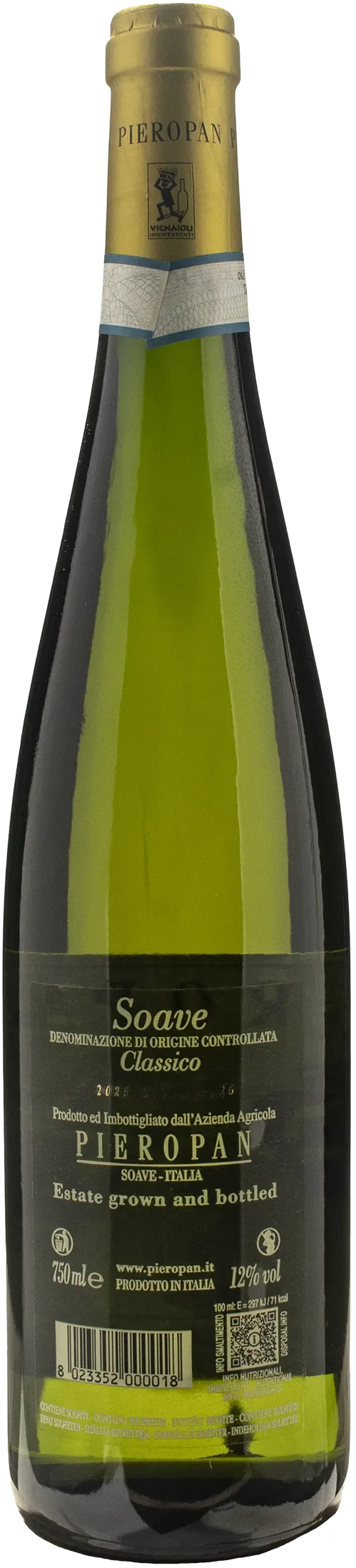
Soave Classico 2025
| Denomination | DOC Soave Classico |
|---|---|
| Size | 0,75 l |
| Alcohol content | 12.0% by volume |
| Area | Veneto (Italy) |
| Grape varieties | 85% Garganega, 15% Trebbiano di Soave |
| Aging | Maturation in vitrified cement tanks in contact with fine lees until bottling in the spring following the harvest; further refinement in the bottle for about a month (or several months) before being released for sale. |
- Name and style: Soave Classico DOC still white, certified organic
- Grapes: 85% Garganega and 15% Trebbiano di Soave, native varieties
- Aromatic profile: hints of white flowers, elderflower, almond, with notes of lime and apple
- Vinification: fermentation at 16–18°C in vitrified cement tanks, ageing on fine lees
- Serving and pairings: serving temperature 8–10°C, ideal with aperitif, asparagus risotto and fish dishes
Description
What kind of wine is it
Pieropan Soave Classico is an organic white wine from Veneto, created from a blend of Garganega and Trebbiano di Soave. In the glass, it shines with a straw yellow colour and green-gold highlights. The bouquet is delicate and floral, characterised by notes of white flowers, elderflower and almond, enriched with hints of apple, lime and marzipan. On the palate, it is dry, savoury and perfectly balanced, with remarkable persistence. It pairs elegantly with vegetable flans, freshwater fish or a classic asparagus risotto.
Where does it come from
The grapes grow in the heart of the Soave Classico area, in the province of Verona. The vineyards are situated at an altitude between 100 and 300 metres, with optimal west-facing exposure. The vines draw nourishment from volcanic soil, a key factor that gives the wine pronounced savoury tension and a pleasant freshness on the palate. The agricultural management follows organic farming practices, aiming to enhance the territorial identity in a sustainable way.
How is it produced
Vinification begins with a rigorous manual harvest, carried out in mid-September for Trebbiano di Soave and in October for Garganega. After destemming and pressing, the free-run must is extracted for fermentation at a controlled temperature in glass-lined cement tanks. The wine matures in the same vessels, where ageing on fine lees imparts structure, roundness and aromatic depth. A final resting period completes the process before release to the market.
History and Curiosities
Pieropan Soave Classico DOC celebrates the long-standing tradition of a family of “Winegrowers since 1880”. This elegant white wine is produced from native grape varieties cultivated organically on the volcanic soils of the Verona area. The manual harvest selects bunches of Garganega and Trebbiano di Soave for vinification. Maturation in glass-lined cement tanks in contact with the fine lees gives the wine structure and complexity, resulting in a fresh and savoury glass, enhanced by elegant notes of white flowers and lime.
Tasting notes

Perfume

Color

Taste
Serve at:
08 - 10 °C
Longevity:
03 - 05 years
- Start up year: 1880
- Oenologist: Dario Pieropan
- Bottles produced: 700.000
- Hectares: 80
Leonildo's idea was simple but at the same time revolutionary: to enhance the individual vineyards and give the wines an identity based on the relationship between variety, soil, climate and human work. The strong link with the territory leads Leonildo to make important choices also for the agronomic management of the vineyard, eliminating chemical weeding in 2002 and starting to convert all production to organic in 2008. In 2008, with other friends, he founded ''FIVI'', the Italian Federation of Independent Winegrowers.
The Valpolicella adventure arrives in the early 2000s, with the acquisition of the Monte Garzon Vineyard and Villa Cipolla in Tregnago, recently renovated and used as a Wine RelaiIs. In a few years Leonildo became the best interpreter of Soave and a point of reference for the national and international markets.
The fourth generation, represented by his sons Andrea and Dario both graduates in agriculture and enology, after the painful loss of their father in 2018, continue the family tradition in the vineyards near Soave with the same love and passion of their forefathers. Read more


| Name | Pieropan Soave Classico 2025 |
|---|---|
| Type | White green still |
| Denomination | Soave DOC |
| Vintage | 2025 |
| Size | 0,75 l |
| Alcohol content | 12.0% by volume |
| Grape varieties | 85% Garganega, 15% Trebbiano di Soave |
| Country | Italy |
| Region | Veneto |
| Vendor | Pieropan |
| Story | History and Curiosities Pieropan Soave Classico DOC celebrates the long-standing tradition of a family of "Winegrowers since 1880". This elegant white wine is produced from native grape varieties cultivated organically on the volcanic soils of the Verona area. The manual harvest selects bunches of Garganega and Trebbiano di Soave for vinification. Maturation in glass-lined cement tanks in contact with the fine lees gives the wine structure and complexity, resulting in a fresh and savoury glass, enhanced by elegant notes of white flowers and lime. |
| Origin | Classic Soave zone (Verona) |
| Soil composition | Volcanic soil |
| Cultivation system | Guyot e pergola veronese |
| Plants per hectare | Guyot: 4,800 vines/ha; Veronese pergola: 3,000 vines/ha |
| Yield per hectare | 80–90 hl/ha (about 2.5 kg per vine) |
| Harvest | Mid-September (Trebbiano di Soave) and October (Garganega) |
| Fermentation temperature | 16–18°C |
| Production technique | Fermentation at controlled temperature (16–18°C) in vitrified cement tanks (glass-lined cement tanks) |
| Wine making | Destemming and pressing of the grapes. Selection of the free-run must and fermentation at a controlled temperature (16 8 °C) in vitrified cement tanks. |
| Aging | Maturation in vitrified cement tanks in contact with fine lees until bottling in the spring following the harvest; further refinement in the bottle for about a month (or several months) before being released for sale. |
| Total acidity | 6.0 gr/L |
| Allergens | Contains sulphites |