


Marchesi di Barolo
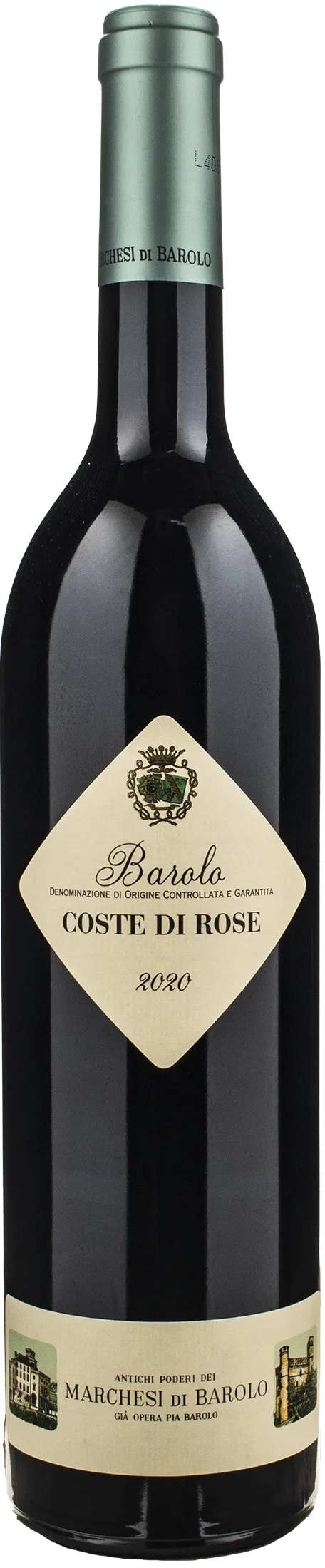
Barolo Coste di Rose 2020
Other years:
2019| Denomination | DOCG Barolo |
|---|---|
| Size | 0,75 l |
| Alcohol content | 14.5% by volume |
| Area | Piedmont (Italy) |
| Grape varieties | 100% Nebbiolo |
| Aging | Initial ageing for two years, partly in Slavonian oak barrels (30 and 36 hectolitres) and partly in small 225-litre French oak casks that are lightly toasted; then further ageing in bottle before release. It reaches maturity four years after the harvest, with a maturation plateau between 4 and 20 years. |
| Other years | 2019 |
- Name and grape: Barolo DOCG 2020, 100% Nebbiolo, 0.75 l, 14.5% vol
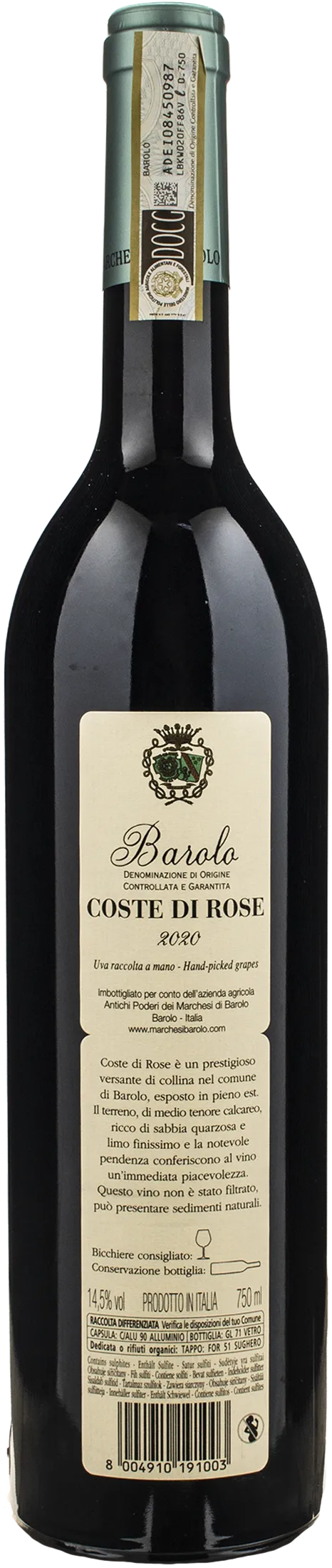
- Coste di Rose terroir: east-facing hillside in the Langhe, sandy and silty soils with quartz
- Vinification and ageing: 10-day maceration, 2 years ageing in Slavonian and French oak
- Aromatic profile: notes of rose, peony, liquorice, spices, aromatic herbs and wild mint
- Development and awards: ready after 4 years, ageing potential of 4–20 years; 94 points Suckling, 92 Spectator
Description
What kind of wine it is
Barolo Coste di Rose by Marchesi di Barolo is a still red wine with Denomination of Controlled and Guaranteed Origin, produced exclusively from Nebbiolo grapes in Piedmont. In the glass, it reveals a ruby red colour with delicate garnet reflections and an aromatic profile dominated by notes of rose, peony, liquorice and wild mint. On the palate, it displays a full and velvety body, supported by perfectly integrated tannins, a testament to careful vinification and lengthy ageing in oak barrels. The sip stands out for its extraordinary capacity for evolution, allowing the wine to achieve a complex expressive maturity over time.
Where it comes from
This wine originates from Coste di Rose, a renowned hill located in the heart of the Langhe. The vineyard is distinguished by its steep slope and favourable eastern exposure, both fundamental factors in ensuring optimal and gradual ripening of the grapes. The soil, characterised by a medium limestone content, is particularly rich in quartz sands and very fine silt. This specific geological composition is responsible for the intense floral imprint and structural elegance that define the wine's profile, faithfully reflecting the microclimatic peculiarities of this historic Piedmontese territory.
How it is produced
The production process begins with a rigorous manual harvest, followed by gentle crushing and destemming to preserve the integrity of the fruit. Alcoholic fermentation takes place in temperature-controlled tanks, accompanied by maceration on the skins and regular pumping over to extract the best polyphenolic fraction. Subsequently, the wine rests in vitrified cement vats to spontaneously complete malolactic fermentation. Ageing involves an initial period in small French oak barrels, useful for stabilising the colour and preserving the aromatic potential, followed by a period in large Slavonian oak casks which imparts further finesse and balance before the final rest.
History and Curiosities
The Barolo DOCG Coste di Rose is born in the heart of the Langhe, on the slopes of a prestigious east-facing hill, tended by the Marchesi di Barolo winery, guardian of two centuries of tradition. The result of a historic vineyard, the wine matures elegantly for two years in wood, then completes its ageing in the bottle, offering an exceptional ageing potential ranging from four to twenty years. Its undisputed class, appreciated by the finest restaurants, is sealed by outstanding scores: 94 points from James Suckling, 92 from Wine Spectator and 91 from Robert Parker.
Awards
-
2020
 94
94/100
James Suckling is an influential American wine critic and journalist who worked at Wine Spectator for 30 years. He left the magazine in 2010 to start his own website and guidebook (JamesSuckling.com). He specialises in Italian and Bordeaux wines.
-
2020
 91
91/100
The prestigious international wine guide from the renowned Robert Parker, the world's most experienced and trusted wine taster.
-
2020
 3
3Italian Sommelier Association (AIS) guide
-
2020
 92
92/100
Wine spectator is the most influential wine guide on the internet.
Tasting notes

Perfume

Color

Taste
Serve at:
18 - 20 °C
Longevity:
10 - 15 years
Decanting time:
1 hour

- Start up year: 1800
- Oenologist: Marco Marsili
- Bottles produced: 1.500.000
- Hectares: 105


| Name | Marchesi di Barolo Barolo Coste di Rose 2020 |
|---|---|
| Type | Red still |
| Denomination | Barolo DOCG |
| Vintage | 2020 |
| Size | 0,75 l |
| Alcohol content | 14.5% by volume |
| Grape varieties | 100% Nebbiolo |
| Country | Italy |
| Region | Piedmont |
| Vendor | Marchesi di Barolo |
| Story | History and Curiosities The Barolo DOCG Coste di Rose is born in the heart of the Langhe, on the slopes of a prestigious east-facing hill, tended by the Marchesi di Barolo winery, guardian of two centuries of tradition. The result of a historic vineyard, the wine matures elegantly for two years in wood, then completes its ageing in the bottle, offering an exceptional ageing potential ranging from four to twenty years. Its undisputed class, appreciated by the finest restaurants, is sealed by outstanding scores: 94 points from James Suckling, 92 from Wine Spectator and 91 from Robert Parker. |
| Origin | Coste di Rose, in the heart of the Langhe (Barolo, Piedmont, Italy) |
| Soil composition | Soil with a medium limestone content, particularly rich in quartz sand and very fine silt |
| Cultivation system | Guyot espalier |
| Plants per hectare | 4000 |
| Fermentation temperature | 24–26 °C |
| Fermentation | 2 months |
| Production technique | Manual harvest; destemming and gentle pressing; alcoholic fermentation at a controlled temperature; maceration with pump-overs (délestage); ageing in Slavonian oak barrels and small French oak casks |
| Wine making | The grapes, freshly harvested, arrive at the winery intact and are quickly and gently crushed and destemmed; fermentation, at a controlled temperature, takes place in temperature-controlled tanks. Maceration lasts 10 days with periodic pump-overs; racking takes place at the end of alcoholic fermentation. The wine is transferred to vitrified cement vats for the initiation and spontaneous completion of malolactic fermentation over the following two months; this is followed by ageing for two years in Slavonian oak barrels and small French oak casks, then further ageing in bottle before release to the market. |
| Aging | Initial ageing for two years, partly in Slavonian oak barrels (30 and 36 hectolitres) and partly in small 225-litre French oak casks that are lightly toasted; then further ageing in bottle before release. It reaches maturity four years after the harvest, with a maturation plateau between 4 and 20 years. |
| Allergens | Contains sulphites |