


Cantine Leonardo da Vinci
1502 Sangiovese Passito Uve Portate a Cesena 2024
| Denomination | DOC Romagna Sangiovese Passito |
|---|---|
| Size | 0,75 l |
| Alcohol content | 15.0% by volume |
| Area | Emilia-Romagna (Italy) |
| Grape varieties | 100% Sangiovese |
| Aging | Aged for 10–12 months in French and American oak barriques |
- Type: Still passito red wine, Sangiovese from Emilia-Romagna 2024, 15% ABV
- Aroma: Notes of ripe dark fruit, vanilla, chocolate, spices and tobacco
- Palate: Smooth and velvety, balanced acidity and soft tannins; long and spicy finish
- Winemaking: Hand-harvested, dried for 60 days; aged in oak for 10–12 months
- Serving and food pairings: Temperature 16–18°C, aerate for 30–45 minutes; ideal with braised meats and cheeses

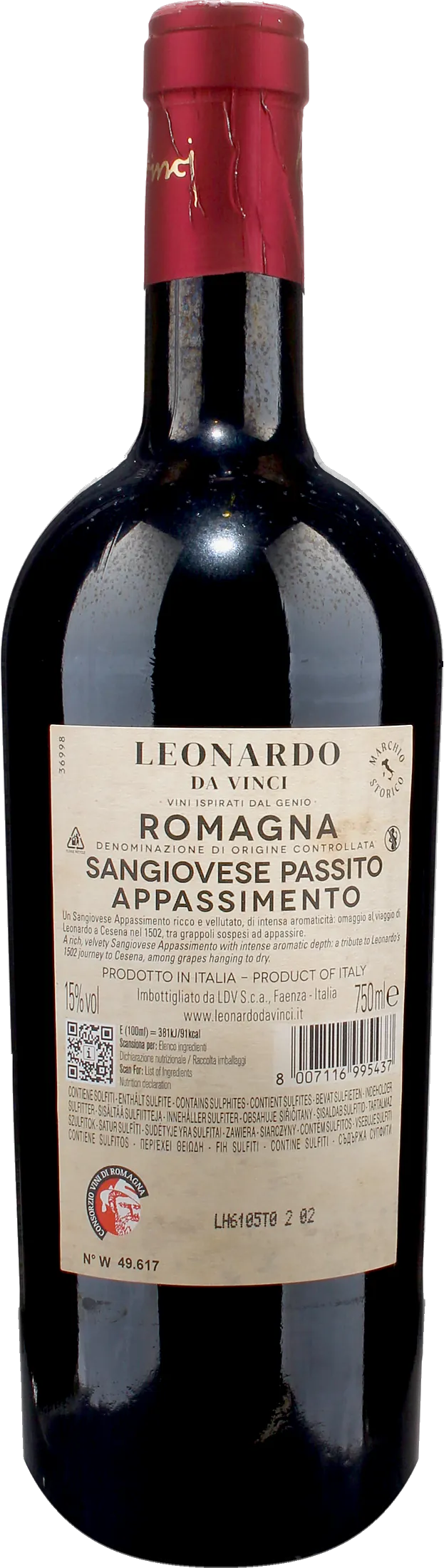
Description
Wine type
1502 Sangiovese Passito Uve Portate a Cesena by Leonardo da Vinci is a still red wine with the Romagna Controlled Designation of Origin (DOC). Obtained from Sangiovese grapes using a meticulous drying technique, it is distinguished by an intense and deep ruby colour. The bouquet is enveloping and blends hints of ripe dark fruit, spices and tobacco, while on the palate it expresses a velvety body, in which the natural acidity is perfectly balanced by soft tannins. The long and fruity finish makes it the ideal pairing for braised meats, game and aged cheeses.
Where it comes from
This Sangiovese originates in Emilia-Romagna, among the hills of Romagna, in an area spanning Castrocaro Terme, Predappio, Bertinoro and Cesena. The vineyards, situated at an altitude between 250 and 350 metres, benefit from a precious diversity of soils: the clayey lands of Predappio provide vigour and power, while the sandstone marls of Bertinoro and Castrocaro bestow finesse and elegance. The wine's name commemorates Leonardo da Vinci's stay in Cesena in 1502, a period during which he deepened his study of local grape dehydration techniques to concentrate their aromas.
How it is produced
The production process begins with the manual harvesting of Sangiovese bunches, which are partially dried on the vine and then left to rest in humidity-controlled drying rooms for at least sixty days. This is followed by fermentation at a controlled temperature in contact with the skins, conducted with delicate extraction techniques. The maturation process includes malolactic fermentation and ageing for approximately ten to twelve months in French and American oak barrels. This wood ageing smooths the tannins and enriches the wine's sensory profile with elegant hints of sweet vanilla.
History and curiosities
In 1502, during his stay in Cesena, Leonardo da Vinci observed the ingenious technique of grape drying (appassimento), a method that still lends a profound character to this Romagna DOC today. Included in the “1502 Da Vinci in Romagna” collection by Cantine Leonardo da Vinci, this wine celebrates the Genius's historic journey through the picturesque vineyards of Castrocaro, Predappio, Bertinoro and Cesena. An elegant masterpiece that pays tribute to the Renaissance master, awarded 99 points by Luca Maroni.
Tasting notes

Perfume

Color

Taste
Serve at:
14 -16 °C
Longevity:
05 - 10 years
Decanting time:
1 hour

- Start up year: 1961
- Oenologist: Riccardo Pucci
- Bottles produced: 5.000.000
- Hectares: 750
The original headquarters, restructured and enlarged, are still the operative centre today. The winery is situated in the borough of Vinci, just 5 kilometres from the birthplace of the world famous artist and inventor Leonardo.
The co-operative takes its name from the great man, paying homage to the mind of the man who was universally recognised as a genius and to emphasise its deep-rooted bond with the territory, the same bond which Leonardo felt and whose surname is specifically associated with the village where he was born on 15 April 1452.
Today, Cantine Leonardo da Vinci is a pioneering co-operative, innovative and modern, which relies on the work and grape production of its 160 members. Read more


| Name | Leonardo da Vinci 1502 Sangiovese Passito Uve Portate a Cesena 2024 |
|---|---|
| Type | Red still |
| Denomination | Romagna DOC |
| Vintage | 2024 |
| Size | 0,75 l |
| Alcohol content | 15.0% by volume |
| Grape varieties | 100% Sangiovese |
| Country | Italy |
| Region | Emilia-Romagna |
| Vendor | Cantine Leonardo da Vinci |
| Story | History and curiosities In 1502, during his stay in Cesena, Leonardo da Vinci observed the ingenious technique of grape drying (appassimento), a method that still lends a profound character to this Romagna DOC today. Included in the "1502 Da Vinci in Romagna" collection by Cantine Leonardo da Vinci, this wine celebrates the Genius's historic journey through the picturesque vineyards of Castrocaro, Predappio, Bertinoro and Cesena. An elegant masterpiece that pays tribute to the Renaissance master, awarded 99 points by Luca Maroni. |
| Origin | Romagna (Castrocaro Terme, Predappio, Bertinoro and Cesena), Emilia-Romagna, Italy |
| Soil composition | Clay soils in Predappio; skeletal marly-sandstone with the presence of stones from Bertinoro to Castrocaro. |
| Cultivation system | Guyot and spurred cordon |
| Harvest | Mid-September |
| Fermentation temperature | 26°C |
| Production technique | Dried grape method |
| Wine making | This red wine is produced using the appassimento (drying) technique: temperature, humidity, ventilation and the percentage weight loss of the grapes are constantly monitored. This is followed by fermentation at a controlled temperature of 26 °C with the inoculation of selected yeasts. |
| Aging | Aged for 10–12 months in French and American oak barriques |
| Allergens | Contains sulphites |