


Le Mortelle (Antinori)
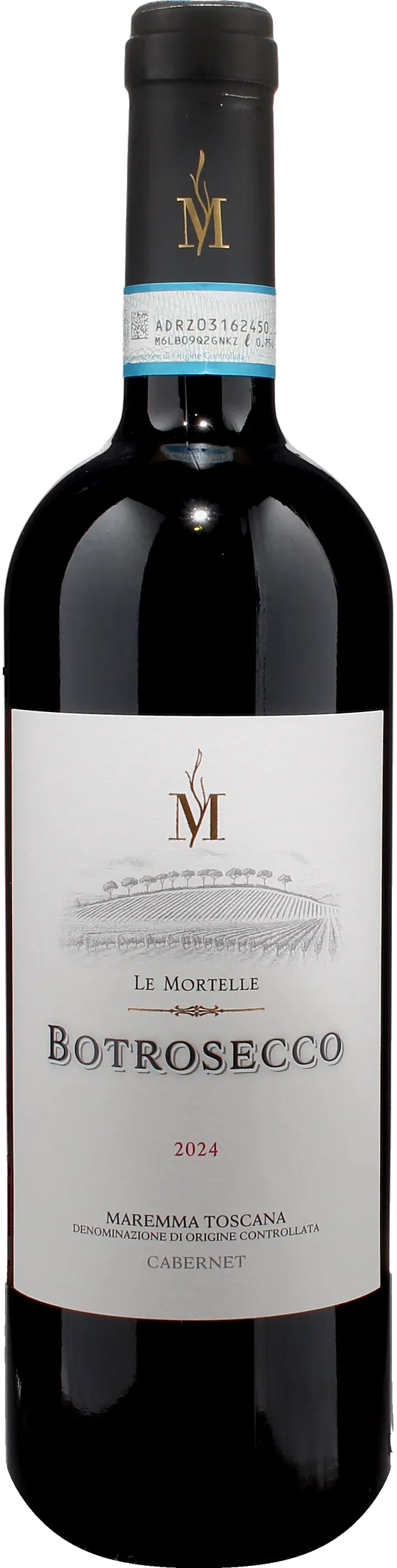
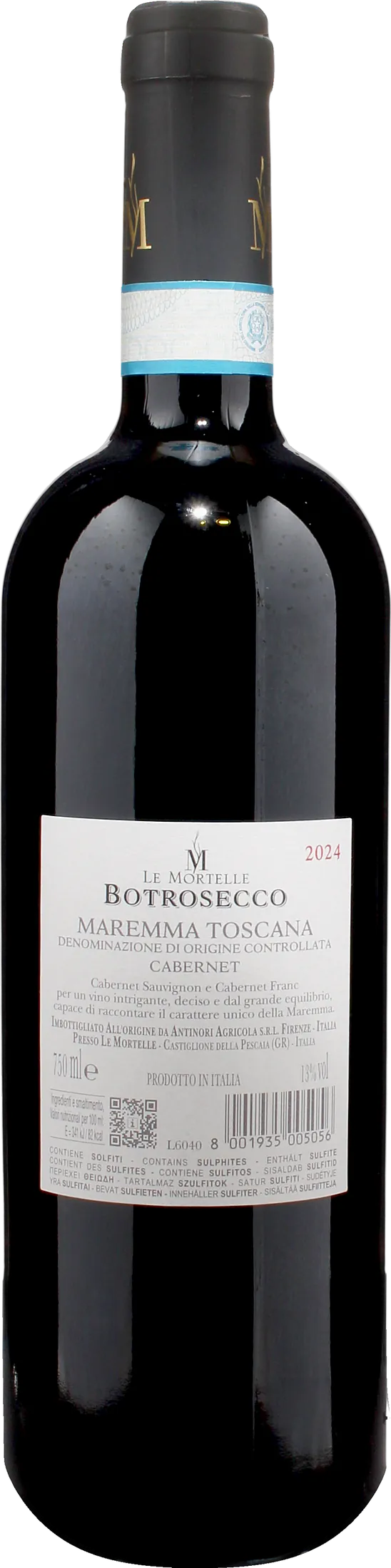
Maremma Toscana Cabernet Botrosecco 2024
| Denomination | DOC Maremma Toscana Cabernet |
|---|---|
| Size | 0,75 l |
| Alcohol content | 13.0% by volume |
| Area | Tuscany (Italy) |
| Grape varieties | 60% Cabernet Sauvignon, 40% Cabernet Franc |
| Aging | Maturation for 12 months in barriques (casks), followed by bottle ageing. |
- Origin: Maremma Toscana DOC red wine 2024
- Grapes: Blend of Cabernet Sauvignon and Cabernet Franc, 13% vol
- Aromas: Hints of blackberry, Mediterranean scrub and velvety tannins
- Winemaking: Gravity-fed, 15 days maceration and 12 months in barriques
- Pairings: Excellent with meat, game and mature cheeses; decant for 1 hour
Description
What type of wine it is
Botrosecco from the Le Mortelle winery is an elegant red wine with the Maremma Toscana Denominazione di Origine Controllata (DOC) status. Crafted from a careful blend of Cabernet Sauvignon and Cabernet Franc grapes, it is distinguished by gravity-flow vinification and subsequent ageing in barrels. The bouquet opens with notes of Mediterranean scrub, blackberry, and balsamic hints of mint and eucalyptus, while the palate is savoury and enveloping, guided by velvety tannins. The balanced texture and persistent finish with hints of cocoa make it ideal for pairing with meat dishes, game, and aged cheeses.
Where it comes from
This wine originates in the Maremma region of Tuscany, a short distance from Castiglione della Pescaia. The vines grow on sandy and silty soils of siliceous-clay origin, a composition that gives the wine definition and smoothness. The significant temperature fluctuations favour the aromatic integrity of the grapes and optimal phenolic maturation. The winery, designed with natural materials and integrated into the subsoil, exploits the natural thermoregulation of the rocks. This stable environment is ideal for guiding the correct evolution of the wine.
How it is produced
After a careful harvest, the bunches are destemmed and softly pressed. The process follows gravity-flow vinification, transferring the must by gravity to the underground cellars to preserve the integrity of the raw material. Fermentation takes place in stainless steel at a controlled temperature, with approximately fifteen days of maceration for the extraction of noble components. Once malolactic fermentation is complete, the wine undergoes twelve months of ageing in barrels, followed by a period of rest in the bottle which defines its structured and persistent profile.
History and trivia
Born on the Le Mortelle estate of the Antinori family, in Maremma, Botrosecco combines excellence and sustainability. The winery, which is partially underground, harnesses the natural thermoregulation of the rocks to reduce its environmental impact. Thanks to careful gravity-flow vinification, the Cabernet Sauvignon and Franc grapes are gently transferred by gravity, preserving their aromatic integrity. Twelve months of ageing in barriques gives this elegant red enveloping aromas and velvety tannins, before final ageing in the bottle.
Tasting notes

Perfume

Color

Taste
Serve at:
14 -16 °C
Longevity:
05 - 10 years
Decanting time:
1 hour

- Start up year: 1999
- Oenologist: Renzo Cotarella
- Hectares: 160
Varieties grown in this area can fully express their own characteristics as well as the exceptional qualities of the terroir. The property extends over an area of 270 hectares (667 acres) 170 of which (420 acres) are planted with vineyards. Read more


| Name | Le Mortelle Maremma Toscana Cabernet Botrosecco 2024 |
|---|---|
| Type | Red still |
| Denomination | Maremma Toscana DOC |
| Vintage | 2024 |
| Size | 0,75 l |
| Alcohol content | 13.0% by volume |
| Grape varieties | 60% Cabernet Sauvignon, 40% Cabernet Franc |
| Country | Italy |
| Region | Tuscany |
| Vendor | Le Mortelle (Antinori) |
| Story | History and trivia Born on the Le Mortelle estate of the Antinori family, in Maremma, Botrosecco combines excellence and sustainability. The winery, which is partially underground, harnesses the natural thermoregulation of the rocks to reduce its environmental impact. Thanks to careful gravity-flow vinification, the Cabernet Sauvignon and Franc grapes are gently transferred by gravity, preserving their aromatic integrity. Twelve months of ageing in barriques gives this elegant red enveloping aromas and velvety tannins, before final ageing in the bottle. |
| Origin | In the heart of the Tuscan Maremma, near Castiglione della Pescaia (Grosseto), Tuscany, Italy |
| Climate | Cool climate with rainfall until June, followed by a generally hot and dry summer; rain in September and high daily temperature variations. |
| Soil composition | Medium-textured soils, sandy and silty, with a siliceous-clay composition |
| Harvest | September (Cabernet Franc in the second half of the month; Cabernet Sauvignon in the last week) |
| Fermentation temperature | Approximately 25 °C |
| Fermentation | Completed by the end of the year |
| Production technique | Gravity-flow vinification; fermentation in temperature-controlled stainless steel tanks (approximately 25°C); maceration for about 15 days; malolactic fermentation in stainless steel; 12 months' maturation in barriques and subsequent bottle ageing. |
| Wine making | After the harvest, the grapes are selected, destemmed and gently crushed; gravity-flow winemaking with the transfer of the must by gravity to the underground levels. Alcoholic fermentation takes place in temperature-controlled stainless steel tanks (at approximately 25 °C), followed by maceration for about 15 days with cap wetting to extract the finest tannins. Malolactic fermentation in stainless steel is completed by the end of the year; maturation lasts 12 months in barriques, followed by ageing in the bottle. |
| Aging | Maturation for 12 months in barriques (casks), followed by bottle ageing. |
| Allergens | Contains sulphites |