


Marchesi Frescobaldi
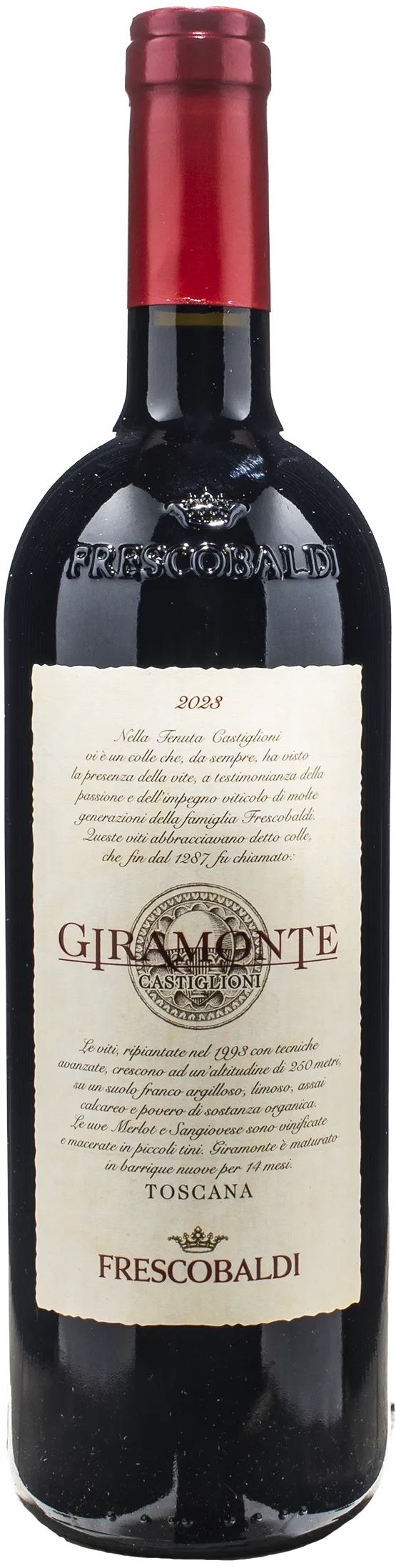
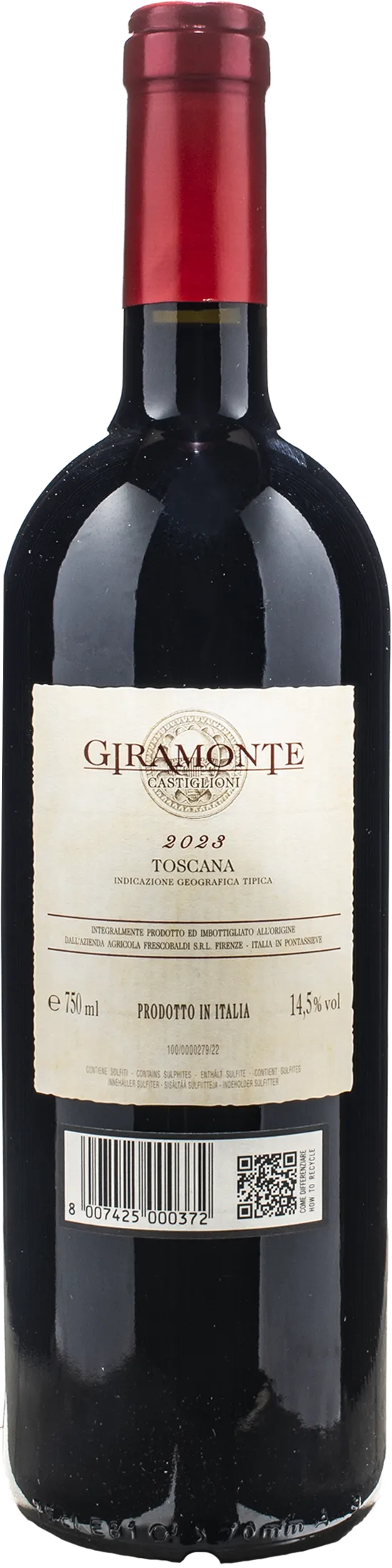
Giramonte 2023
| Denomination | IGT Toscana |
|---|---|
| Size | 0,75 l |
| Alcohol content | 14.5% by volume |
| Area | Tuscany (Italy) |
| Grape varieties | 80% Merlot, 20% Sangiovese |
| Aging | 14 months in new barriques and 6 months in bottle |
- Composition and origin: 80% Merlot, 20% Sangiovese; Castiglioni, Montespertoli (Florence)
- Vinification: spontaneous fermentation in stainless steel; malolactic fermentation in barriques
- Maturation: 14 months in new French oak barriques followed by 6 months in the bottle
- Aromas: black cherry and blackberry; toasted notes of hazelnut, coffee, cocoa; sweet spices
- Rating: 97 points James Suckling; silky tannins and a long, persistent finish
Description
What type of wine it is
Marchesi Frescobaldi's Giramonte is a still red wine from Tuscany that expresses the authentic essence of its terroir. The result of a refined blend of Merlot and Sangiovese, it is distinguished by an intense and impenetrable ruby-red colour. On the palate, it reveals a full structure, supported by a silky and enveloping tannic texture. The aromatic profile is complex, led by notes of black cherry and blackberry that intertwine with toasted hints of hazelnut, coffee and cocoa. Ageing enriches the bouquet with spicy nuances of cloves, offering a long and persistent finish with every sip.
Where it comes from
This wine originates from the Tenuta di Castiglioni, located in the municipality of Montespertoli. The vineyards enjoy excellent south-west exposure and are situated at an altitude of approximately two hundred metres. The vines are trained using the spurred cordon system on sandy and clay-silt soils, a pedological composition ideal for obtaining grapes of great concentration and structure. The temperate climate of the area, characterised by hot summers mitigated by well-distributed rainfall, promotes optimal ripening. The manual harvest allows only the healthiest and most balanced bunches to be selected, ready for processing in the cellar.
How it is produced
The winemaking process begins with separate skin maceration for the Merlot and Sangiovese, aimed at precisely extracting the colour and polyphenolic components. Spontaneous alcoholic fermentation takes place in temperature-controlled stainless steel tanks, with gentle pump-overs to preserve the aromatic integrity of the must. Malolactic fermentation occurs directly in wood. Ageing continues for fourteen months in new French oak barrels, where the wine acquires breadth and complexity, before concluding with the necessary resting in the bottle to refine its final character.
History and interesting facts
Created in 1999 at the historic Castiglioni Estate in Montespertoli, Giramonte 2023 is the rarest and most exclusive Cru of the Marchesi Frescobaldi family. This elegant Toscana IGT originates from sandy-clay soils at 200 metres above sea level, where a rigorous selection of Merlot and Sangiovese grapes ensures absolute excellence. Careful ageing in new French oak barriques shapes its vigorous and silky character, awarded 97 points by James Suckling, offering a harmonious experience of extraordinary persistence.
Awards
-
2023
 97
97/100
James Suckling is an influential American wine critic and journalist who worked at Wine Spectator for 30 years. He left the magazine in 2010 to start his own website and guidebook (JamesSuckling.com). He specialises in Italian and Bordeaux wines.
Tasting notes

Perfume

Color

Taste
Serve at:
16 - 18 °C
Longevity:
10 - 15 years
Decanting time:
1 hour
- Start up year: 1300
- Oenologist: Nicolò D'Afflitto
- Hectares: 923
One thousand years of family history are a unique and incomparable treasure of knowledge and tradition. It is our duty to share this passion with future generations, passing on our love for these eternal places, these eternal hills. Read more


| Name | Frescobaldi Giramonte 2023 |
|---|---|
| Type | Red still |
| Denomination | Toscana IGT |
| Vintage | 2023 |
| Size | 0,75 l |
| Alcohol content | 14.5% by volume |
| Grape varieties | 80% Merlot, 20% Sangiovese |
| Country | Italy |
| Region | Tuscany |
| Vendor | Marchesi Frescobaldi |
| Story | History and interesting facts Created in 1999 at the historic Castiglioni Estate in Montespertoli, Giramonte 2023 is the rarest and most exclusive Cru of the Marchesi Frescobaldi family. This elegant Toscana IGT originates from sandy-clay soils at 200 metres above sea level, where a rigorous selection of Merlot and Sangiovese grapes ensures absolute excellence. Careful ageing in new French oak barriques shapes its vigorous and silky character, awarded 97 points by James Suckling, offering a harmonious experience of extraordinary persistence. |
| Origin | Tenuta di Castiglioni, Comune di Montespertoli (FI) |
| Climate | Altitude: 250 m above sea level. Exposure: South-West. The harvest immediately proved to be particularly good thanks to the favourable seasonal trend. The spring months were characterised by mild weather, with scarce rainfall and no thermal stress: this promoted good phytosanitary conditions for the grapes. At the end of May, there was a sudden drop in temperatures which caused no damage, but led to a slight slowdown in the plant's phenology and a higher percentage of unfertilised flowers. This physiological condition resulted in looser (i.e. less compact) and therefore healthier bunches. In July, temperatures were high, while August was cool with moderate rainfall: a varied thermal regime that ensures very interesting aromatic characteristics, rich in intensity and complexity. |
| Soil composition | Silty clay |
| Cultivation system | Spurred cordon |
| Plants per hectare | 5500 |
| Yield per hectare | 25 h |
| Harvest | Merlot: last week of September, Sangiovese: early October - Manual. |
| Fermentation temperature | Controlled |
| Fermentation | 12 days. |
| Production technique | Spontaneous alcoholic fermentation in temperature-controlled stainless steel tanks with gentle pump-overs; malolactic fermentation and ageing in new barriques. |
| Wine making | In stainless steel tanks. Maceration time on the skins: Merlot 20 days, Sangiovese 15 days. Malolactic fermentation: carried out in barriques immediately after alcoholic fermentation. |
| Aging | 14 months in new barriques and 6 months in bottle |
| Allergens | Contains sulphites |