


Foss Marai
Roos Brut
| Denomination | VSQ |
|---|---|
| Size | 0,75 l |
| Alcohol content | 11.5% by volume |
| Area | Veneto (Italy) |
| Grape varieties | Cabernet Sauvignon, Montepulciano, Sagrantino, Sangiovese |
| Aging | Secondary fermentation in a pressurised tank for 30–40 days (Charmat method) |
- Style and strength: Semi-aromatic Brut rosé sparkling wine, 11.5% vol, 0.75 l bottle
- Grape varieties: Blend of Cabernet Sauvignon, Montepulciano, Sagrantino and Sangiovese
- Charmat method: hand-picked and refermented for 30–40 days in a pressurised tank
- Aromatic profile: notes of wild berries, blueberries and cornelian cherry, complex bouquet
- Taste and pairings: rounded entry and fresh finish; ideal with aperitifs, pasta, fish and shellfish
Description
What kind of wine is it
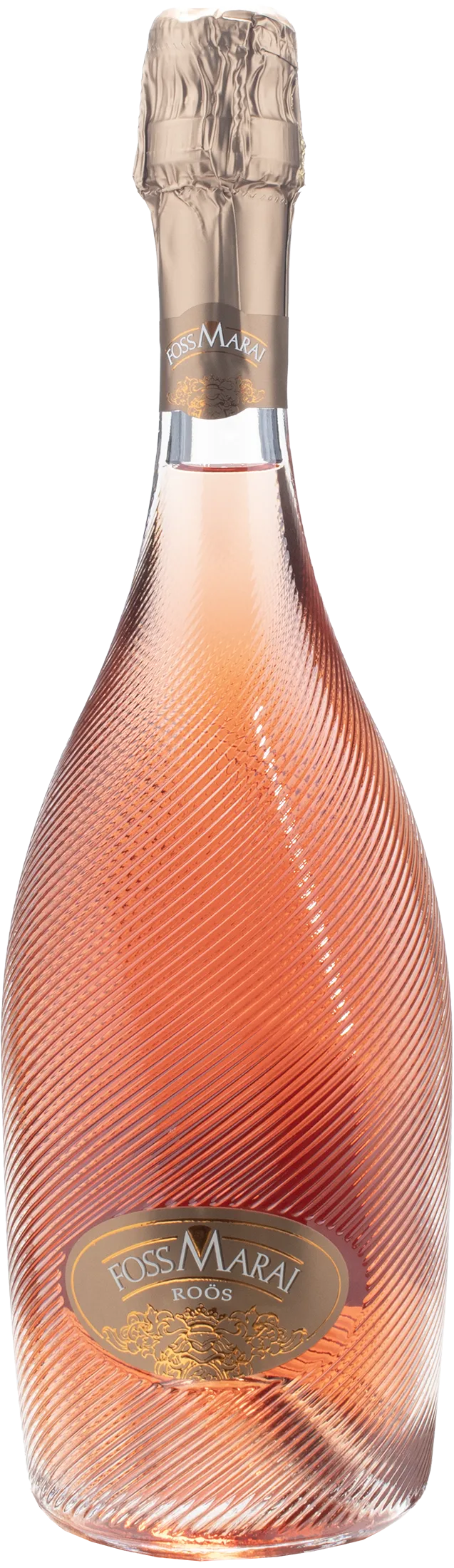
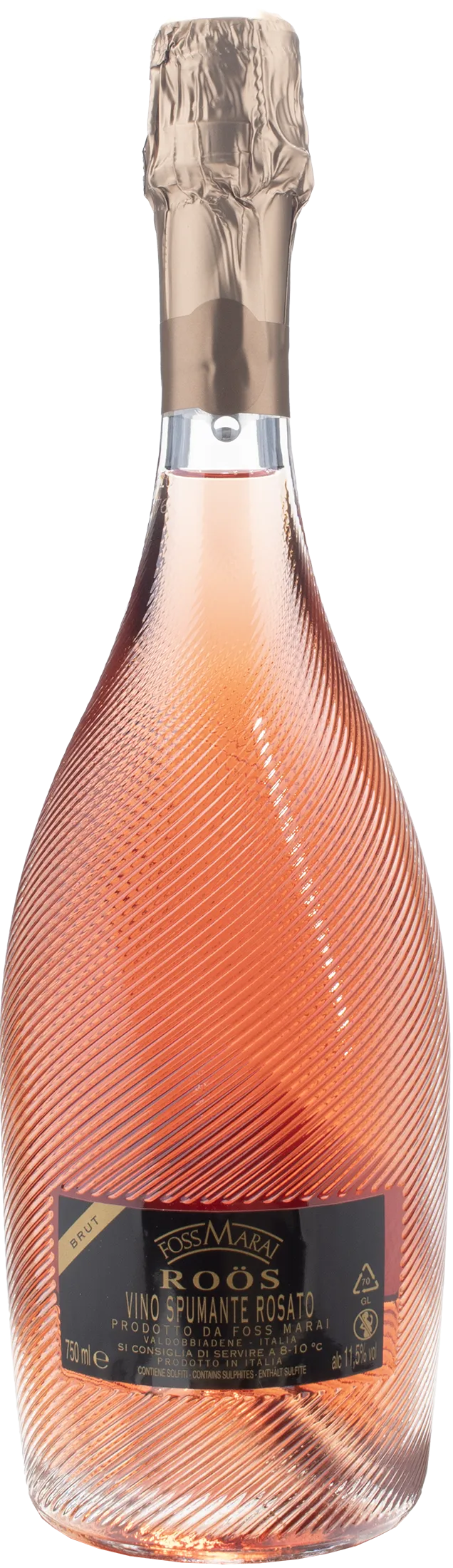
Foss Marai Roos Brut is a semi-aromatic Brut rosé sparkling wine, created from a blend of Cabernet Sauvignon, Montepulciano, Sagrantino and Sangiovese. In the glass, it displays a petal pink colour with ruby highlights. The bouquet is complex, with notes of wild berries, blueberry and cornelian cherry. On the palate, it opens round and then evolves into a fragrant and refreshing sip. Versatile, it is enjoyable as an aperitif and pairs well with first courses, shellfish or aromatic cheeses.
Where does it come from
The grapes are grown in estate-owned vineyards located in Corato, at around five hundred metres above sea level. In this area, the significant temperature variation between day and night ensures optimal ripening, preserving the aromatic freshness of the grapes. The vines, trained using the double Guyot system, allow for a perfect balance between growth and yield. This careful management enables Foss Marai to obtain an ideal base for the subsequent sparkling process.
How is it produced
Production begins in September with the manual harvest. The bunches are pressed and the must is immediately separated from the skins to limit the extraction of colour and tannins. The blend of varieties takes place before fermentation at a controlled temperature. The prise de mousse follows the Charmat method in a pressurised tank for thirty to forty days with selected yeasts. This technique defines the perlage, giving a fragrant structure consistent with the winery's style.
History and Curiosities
Roös Brut embodies the perfect union of four noble grape varieties grown at almost five hundred metres above sea level, where the significant temperature variation promotes optimal ripening. Hand-picked at the beginning of September, the grapes are vinified by Foss Marai using the Charmat method, resulting in a fragrant and refreshing profile. The secondary fermentation, combined with the use of selected yeasts, enhances the aromatic complexity of the blend. Thus is born a prestigious rosé sparkling wine which, since 1984, has celebrated the tradition and ongoing pursuit of quality by the winery.
Tasting notes

Perfume

Color

Taste
Serve at:
06 - 08 °C
Longevity:
03 - 05 years
- Start up year: 1984
- Oenologist: Carlo Biasiotto, Fabio Men
- Bottles produced: 1.600.000
This approach allows the company to offer new products, but also constantly improve its wines, which undergo strict assessment by a group of oenologists, known as the "club of the wise men", who perform rigorous blindfolded tastings. The Company’s journey is thus a "slow and continuous" path toward improvement and excellence. Thus, the quality of Foss Marai comes from years of experience and craftsmanship, daily research and continuous technological innovation. A quality that is always at the highest level, in the international wine market, with the best Italian sparkling wines. Read more


| Name | Foss Marai Roos Brut |
|---|---|
| Type | Rosé charmat method sparkling wine brut semi-aromatic |
| Denomination | VSQ |
| Size | 0,75 l |
| Alcohol content | 11.5% by volume |
| Grape varieties | Cabernet Sauvignon, Montepulciano, Sagrantino, Sangiovese |
| Country | Italy |
| Region | Veneto |
| Vendor | Foss Marai |
| Story | History and Curiosities Roös Brut embodies the perfect union of four noble grape varieties grown at almost five hundred metres above sea level, where the significant temperature variation promotes optimal ripening. Hand-picked at the beginning of September, the grapes are vinified by Foss Marai using the Charmat method, resulting in a fragrant and refreshing profile. The secondary fermentation, combined with the use of selected yeasts, enhances the aromatic complexity of the blend. Thus is born a prestigious rosé sparkling wine which, since 1984, has celebrated the tradition and ongoing pursuit of quality by the winery. |
| Origin | Corato (Bari) |
| Cultivation system | Double Guyot |
| Plants per hectare | 3600 plants/ha |
| Yield per hectare | 95-98 q/ha |
| Harvest | First ten days of September |
| Fermentation temperature | 17 °C |
| Fermentation | 30–40 days |
| Production technique | Charmat method: manual harvest, crushing and immediate separation of the must from the skins; temperature-controlled fermentation (17 °C) with selected yeasts; secondary fermentation in an autoclave for 30–40 days with the addition of sucrose and selected yeasts. |
| Wine making | Manual harvest in the first ten days of September; crushing and immediate separation of the must from the skins to limit extraction of colour and tannins; blending of the grapes directly in the vineyard during the harvest; fermentation at a controlled temperature (17 °C) with selected yeasts; secondary fermentation using the Charmat method in a pressurised tank for 30–40 days with the addition of sucrose and selected yeasts. |
| Aging | Secondary fermentation in a pressurised tank for 30–40 days (Charmat method) |
| Total acidity | 6.0 gr/L |
| Residual sugar | 6.0 gr/L |
| Allergens | Contains sulphites |