


Fontanafredda
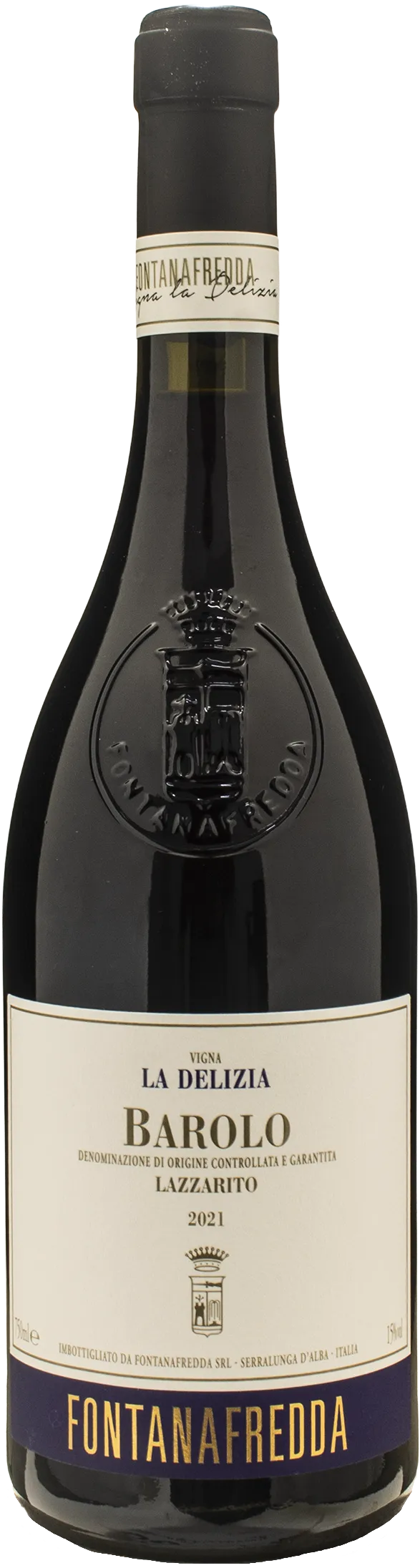
Barolo Lazzarito Vigna La Delizia 2021
| Denomination | DOCG Barolo |
|---|---|
| Size | 0,75 l |
| Alcohol content | 15.0% by volume |
| Area | Piedmont (Italy) |
| Grape varieties | 100% Nebbiolo |
| Aging | It begins in Allier oak barriques for about 12 months and continues in Allier casks of 2,000–3,000 litres for a further year; if necessary, a clarification is carried out, then the wine is bottled and matured for at least one year before being released for sale. |
- Name and grape: Barolo DOCG made from 100% Nebbiolo, 2021 harvest
- Aromatic characteristics: notes of ripe plum, tobacco, liquorice, dried mushrooms and spices
- Vinification: 20–30 days maceration with délestage and malolactic fermentation at 20°C
- Ageing: 12 months in Allier barriques followed by 12 months in 2,000–3,000 litre casks
- Serving and pairings: decant for 1 hour; serve at 18–20°C with meats, game and cheeses

Description
What kind of wine it is
Barolo Lazzarito Vigna La Delizia by Fontanafredda is a organic red wine of great structure, capable of evolving magnificently over time. Made from Nebbiolo grapes, it displays a ruby red colour with garnet highlights. The aromatic bouquet is characterised by distinct notes of ripe plum, tobacco, liquorice and dried mushrooms, accompanied by hints of nutmeg and white pepper. On the palate, it reveals a dense and tightly-knit tannic texture that gives compactness to the sip, while maintaining excellent harmony. The complexity of this Barolo stems from skilful ageing in Allier oak barrels, which shapes its elegant character and remarkable longevity.
Where it comes from
The grapes are grown in the Vigna La Delizia in Serralunga d’Alba, in the heart of the Langhe. The vineyard is situated in a natural hollow at 400 metres above sea level, enhanced by an optimal south and south-west exposure. The vines are trained using the Guyot system on marine sedimentary soils dating back to the Miocene-Elvezian era. These soils are distinguished by a marked presence of white-greyish calcareous marl, a fundamental element that gives the wine a natural structural tension and a profound territorial expression, in full respect of organic and sustainable cultivation methods.
How it is produced
After the harvest in early October, the grapes undergo a maceration with délestage for about thirty days at a controlled temperature, followed by malolactic fermentation. Maturation begins in Allier oak barrels for one year and continues for a further twelve months in additional Allier barrels that refine the gustatory balance without overpowering the fruit. Certified vegan, this wine is aged in bottle for at least another year. It is recommended to decant for an hour and serve between 18 and 20 degrees to best accompany red meats, pork, game and long-aged cheeses.
History and Curiosities
Founded in 1878 in the Langhe, the historic Fontanafredda estate enhances the noble essence of Serralunga d’Alba. In a picturesque south-facing hollow, at an altitude of 400 metres, the prestigious Barolo Lazzarito Vigna La Delizia is born. The vines sink their roots into soils rich in calcareous marl, giving this organic wine an elegant and unmistakable structure. The extraordinary 2021 vintage was awarded an impressive 95 points by Decanter, confirming its absolute oenological excellence.
Awards
-
2021
 5
5Italian Sommelier Foundation (FIS) guide This has been one of the most prestigious wine guides in Italy for over 10 years.
-
2021
 95
95/100
Decanter is a wine and lifestyle magazine, published monthly in around 90 countries. The magazine includes industry news, classic guides and advice on wine and spirits.
-
2021
 95
95/100
James Suckling is an influential American wine critic and journalist who worked at Wine Spectator for 30 years. He left the magazine in 2010 to start his own website and guidebook (JamesSuckling.com). He specialises in Italian and Bordeaux wines.
-
2021
 3
3One of the most prestigious wine guides in Italy.
-
2021
 95
95/100
Wine spectator is the most influential wine guide on the internet.
Tasting notes

Perfume

Color

Taste
Serve at:
18 - 20 °C
Longevity:
10 - 15 years
Decanting time:
1 hour
- Start up year: 1878
- Oenologist: Giorgio Lavagna
- Bottles produced: 7.000.000
- Hectares: 120
Like all beautiful things, Fontanafredda originates from a love story between the first King of Italy, Vittorio Emanuele II, and Rosa Vercellana.
Producers of Barolo and sumptuous wines of the Langhe, it was the scene of many firsts: they were the first Barolo to go overseas, the first to produce the first Classic Method in 1959, which was to be the forerunner of Alta Langa.
The founding principle of the winery is the concept of community.
Since 2018, Fontanafredda has been cultivating 120 organically certified hectares that are the setting for Italy's first Storytelling Village ('Villaggio Narrante'), which is still home to 12 families of workers who make the village an authentic village, alive and productive.
Fontanafredda is also hospitality, a meeting place where everyone is welcome thanks to its 4-star hospitality.
Today, the company preserves intact the testimonies of its noble past - the hunting lodge, the village, the extensive cellars, the vineyards - but continues to renew itself and experiment, perfecting what nature and history have handed down. For this reason, in the Langhe, where vines and wine bind generations to each other and shape the landscape, Fontanafredda is an essential reference point. The expression of a wine culture that comes from the earth, from the vineyard, and is refined through the work and creativity of people.
In 2021, the Alta Langa DOCG Contessa Rosa Rosé 2014 was named 'Best Sparkling Wine in the World' according to Tastingbook 2021.
In 2022 the BAROLO SERRALUNGA 2018 entered the TOP100 of WINE SPECTATOR in 78th place. Read more


| Name | Fontanafredda Barolo Lazzarito Vigna La Delizia 2021 |
|---|---|
| Type | Red organic still |
| Denomination | Barolo DOCG |
| Vintage | 2021 |
| Size | 0,75 l |
| Alcohol content | 15.0% by volume |
| Grape varieties | 100% Nebbiolo |
| Country | Italy |
| Region | Piedmont |
| Vendor | Fontanafredda |
| Story | History and Curiosities Founded in 1878 in the Langhe, the historic Fontanafredda estate enhances the noble essence of Serralunga d’Alba. In a picturesque south-facing hollow, at an altitude of 400 metres, the prestigious Barolo Lazzarito Vigna La Delizia is born. The vines sink their roots into soils rich in calcareous marl, giving this organic wine an elegant and unmistakable structure. The extraordinary 2021 vintage was awarded an impressive 95 points by Decanter, confirming its absolute oenological excellence. |
| Origin | "La Delizia" Vineyard, municipality of Serralunga d'Alba, situated in a natural basin in a mid-hill position (400 m a.s.l.) with south and south-west exposure |
| Soil composition | Soil of marine sedimentary origin (Miocene-Helvetian), rich in calcareous marl, greyish-white in colour |
| Cultivation system | Guyot |
| Plants per hectare | 4500 |
| Harvest | Prima-seconda decade di ottobre |
| Fermentation temperature | Circa 32–33 °C iniziali, poi ridotta a circa 25 °C; fermentazione malolattica a circa 20 °C |
| Fermentation | 20–30 days |
| Production technique | Maceration for 20–30 days with délestage and malolactic fermentation; ageing in barriques and Allier oak barrels |
| Wine making | The grapes are destemmed and crushed, heated to around 32–33 °C, and subjected to immediate and very frequent pump-overs during the first 3 days to maximise the extraction of colour and tannins. As the alcohol content increases, the temperature is reduced to around 25 °C and the volume of pump-overs is decreased to avoid excessive extraction. Maceration lasts 20–30 days with délestage to optimise tannin extraction and oxygenate the yeasts. At the end of the alcoholic fermentation, malolactic fermentation follows immediately at around 20 °C in temperature-controlled containers. |
| Aging | It begins in Allier oak barriques for about 12 months and continues in Allier casks of 2,000–3,000 litres for a further year; if necessary, a clarification is carried out, then the wine is bottled and matured for at least one year before being released for sale. |
| Allergens | Contains sulphites |