


Feudo Principi di Butera
Syrah Butirah 2022
| Denomination | DOC Sicilia Syrah |
|---|---|
| Size | 0,75 l |
| Alcohol content | 14.0% by volume |
| Area | Sicily (Italy) |
| Grape varieties | 100% Syrah |
| Aging | Aged for 12 months in large 60 hl Slavonian oak barrels, followed by further refinement in the bottle |
- Grape variety and designation: 100% Syrah, Sicilia DOC, vintage 2022, 14% vol
- Aroma: notes of morello cherry and red fruits with hints of vanilla, cinnamon and exotic spices
- Taste: dry, full and enveloping, well-balanced tannins, long and velvety finish
- Ageing: 12 months in Slavonian oak barrels followed by further ageing in bottle
- Serving: 16–18 °C, decant for 1 hour; ideal with stews, game and mature cheeses
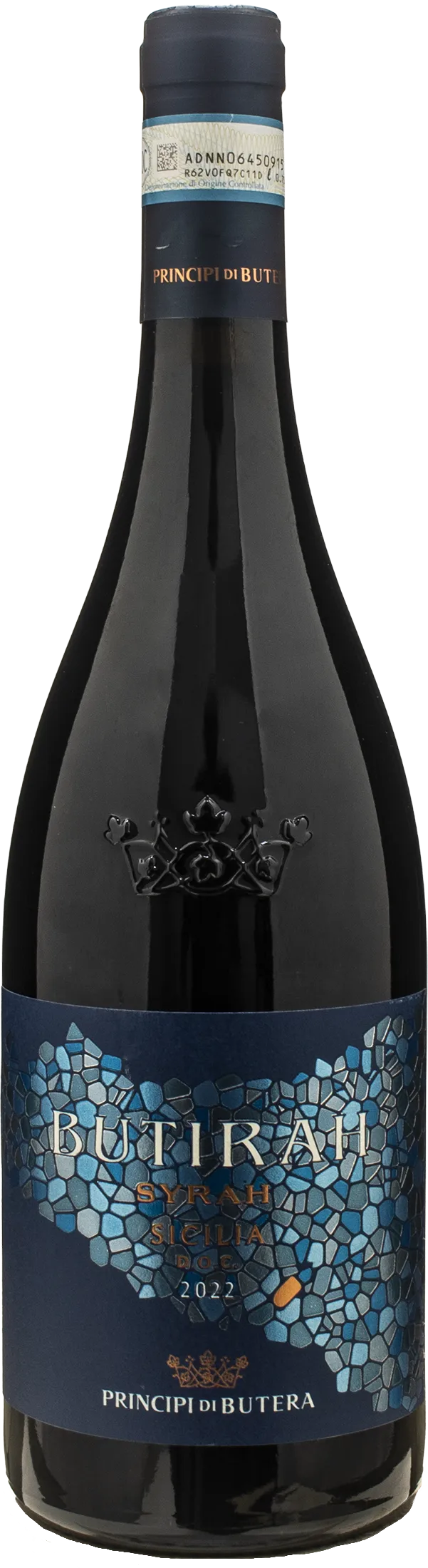
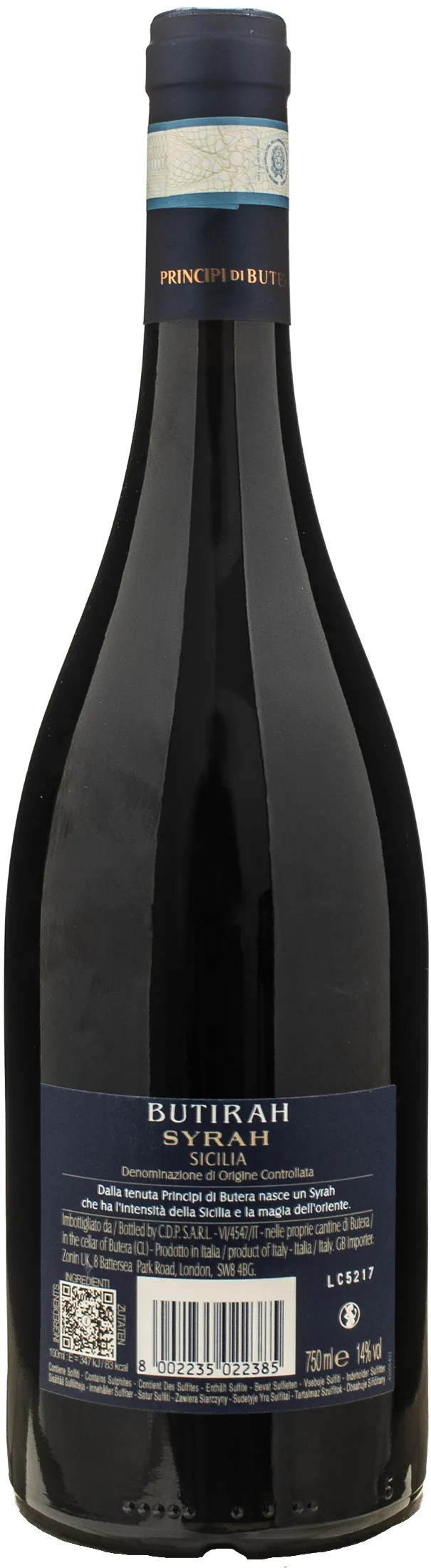
Description
What kind of wine it is
Butirah Syrah by Principi di Butera is a dry red wine with a pronounced personality, serving as an authentic expression of the Sicilian territory. Made from Syrah grapes, it appears a brilliant, deep ruby colour in the glass. Its sensory profile is defined by a broad and persistent bouquet, where notes of morello cherry and red fruits stand out, enriched by elegant hints of vanilla, cinnamon, and exotic spices. On the palate, it reveals a robust and enveloping structure, with a full body and juicy fruit component resting on well-balanced tannins, leading to a long and velvety finish.
Where it comes from
This label originates from central-southern Sicily, in the areas between Butera and Riesi. Here, the vineyards benefit from a warm Mediterranean climate, tempered by constant sea breezes that promote perfect aromatic ripening of the grapes. The vines grow on mineral-rich, calcareous soils, with clay, basalt, and sand, which give the wine concentration and a distinctive spicy note. The name Butirah recalls the ancient Arabic root of the city, evoking the exotic and oriental soul of a land that has always been a crossroads of Mediterranean cultures.
How it is produced
Production involves the manual harvesting of the grapes, followed by temperature-controlled fermentation lasting about eight days, aimed at extracting colour and aromas in balance. Afterwards, the wine matures for twelve months in large Slavonian oak barrels, a crucial stage for refining its elegance while preserving the integrity of the fruit. The evolution concludes with a further period of rest. Ideal when paired with slow-cooked meats, game, or mature cheeses, it enhances flavours thanks to its intensity.
History and Curiosities
The name Butirah recalls the ancient Arabic root of Butera, celebrating the exotic soul of Sicily, which has always been a crossroads between East and West. Founded in 1997 in Contrada Deliella, the Principi di Butera estate produces a fine pure Syrah that faithfully reflects a unique terroir, caressed by sea breezes. Under the guidance of oenologist Antonio Paolo Froio, this exceptional Sicilia DOC with a marked Levantine character comes to life. Its seductive spicy character blends with a juicy and enveloping fruitiness.
Tasting notes

Perfume

Color

Taste
Serve at:
16 - 18 °C
Longevity:
05 - 10 years
Decanting time:
1 hour

- Start up year: 1997
- Oenologist: Antonio Paolo Froio
- Bottles produced: 800.000
- Hectares: 180
The name Butera appears to have its origins in Re Bute, the first king of the Siculi, who along with the Sicani and Grek colonisers, inhabited the strategically important southern central region of Sicily which acted as the border between the three civilisations.
Saracen occupation of the island started in 854 AD and continued until their expulsion in 1089 at the hands of the Norman Roger of Altavilla. The history of the principality was then characterised by three great families in succession: the Santapau, the Bracinforte and the Lanza.
The Santapau held the Feudo Principi di Butera for two centuries before ceding it to the Bracinforte, a noble family originally from the Piacenza region. In 1543 King Philip of Spain then nominated Ambrogio Bracinforte as Lord of Feudo Principi di Butera, which remained the most important noble title in Sicily up until the 19th century. The Bracinforte dynasty became one of the most powerful in the history of Sicily and it is estimated that at the turn of the 18th century they owned what amounted to about ten percent of the entire island’s income.
The Bracinforte dynasty came to an end with marriage of Stefania Bracinforte to Guiseppe Lanza, whose union brought together into one family dozens of titles, hundreds of manor houses, thousands of hectares of land and unbound riches. In 1895 the Lanza heir was also awarded the title of Prince of Deliella.
In the previous century, the Italian Royal Family of Savoia had founded the Principality of Deliella, on the very lands which today represent the borders of the Feudo Principi di Butera
The ancient Baglio (fortified manor house) of the Feudo Principi di Butera, having been completely restored with great attention being paid to its ancient structures, has come back to life and the intense ochre colours of its walls are even more striking when they meet the incredible blues and greens of the surrounding Sicily.
The Zonin family has thus also taken on the role of custodian of the territory, convinced that they have a definite responsibility to care for and highlight the history, architecture and landscape of the island. Read more


| Name | Feudo Principi di Butera Syrah Butirah 2022 |
|---|---|
| Type | Red still |
| Denomination | Sicilia DOC |
| Vintage | 2022 |
| Size | 0,75 l |
| Alcohol content | 14.0% by volume |
| Grape varieties | 100% Syrah |
| Country | Italy |
| Region | Sicily |
| Vendor | Feudo Principi di Butera |
| Story | History and Curiosities The name Butirah recalls the ancient Arabic root of Butera, celebrating the exotic soul of Sicily, which has always been a crossroads between East and West. Founded in 1997 in Contrada Deliella, the Principi di Butera estate produces a fine pure Syrah that faithfully reflects a unique terroir, caressed by sea breezes. Under the guidance of oenologist Antonio Paolo Froio, this exceptional Sicilia DOC with a marked Levantine character comes to life. Its seductive spicy character blends with a juicy and enveloping fruitiness. |
| Origin | Municipalities of Butera and Riesi (province of Caltanissetta), Sicily, Italy |
| Climate | Warm Mediterranean climate |
| Soil composition | Limestone, clay, mineral basalt and sand |
| Fermentation temperature | 28–30 °C |
| Fermentation | About 8 days |
| Production technique | Hand-picked grapes; fermentation at controlled temperature (28–30 °C) for about 8 days; maturation for 12 months in large Slavonian oak barrels (60 hl) with further ageing in bottle |
| Wine making | Hand-picked grapes, gently processed; fermentation at a controlled temperature of 28–30 °C for about 8 days; maturation for 12 months in large 60 hl Slavonian oak barrels, followed by further ageing in the bottle. |
| Aging | Aged for 12 months in large 60 hl Slavonian oak barrels, followed by further refinement in the bottle |
| Allergens | Contains sulphites |