


Pasqua Vigneti e Cantine
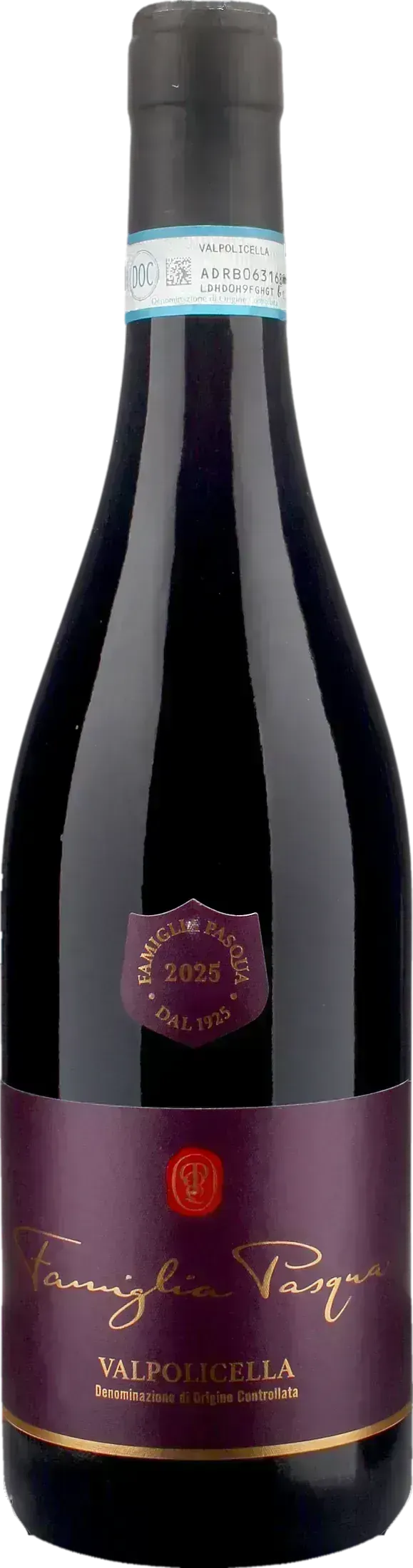
Valpolicella 2025
| Denomination | DOC Valpolicella |
|---|---|
| Size | 0,75 l |
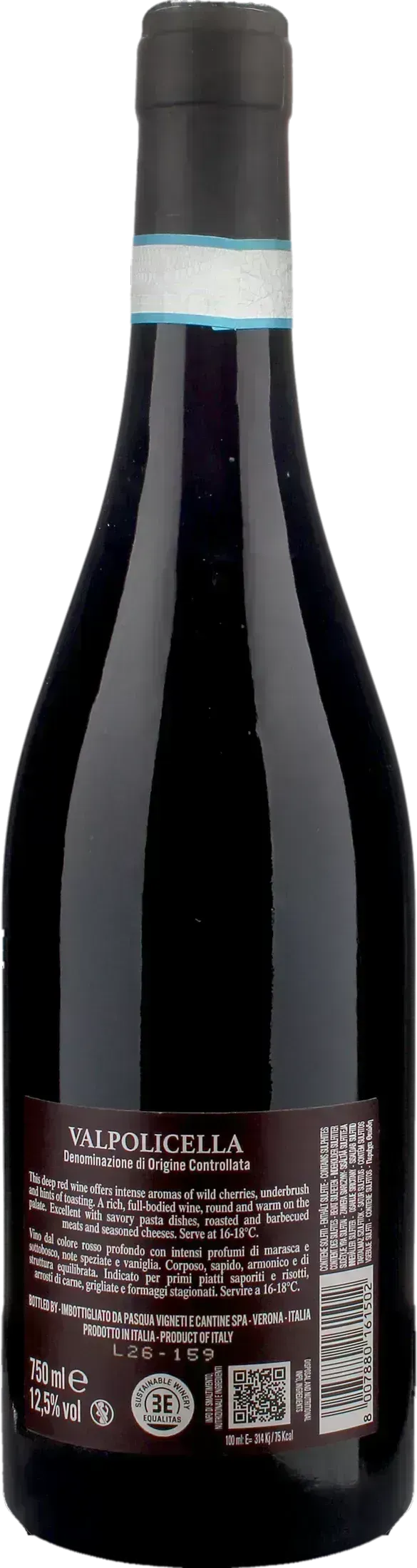
| Alcohol content | 12.5% by volume |
| Area | Veneto (Italy) |
| Grape varieties | 60% Corvina, 25% Corvinone, 10% Rondinella, 5% Croatina |
| Aging | Following malolactic fermentation, it matures in barriques for several months before bottling. |
- Type: Still red wine with a protected designation of origin from Valpolicella, Veneto
- Grape varieties: Selection of Corvina, Corvinone, Rondinella and Croatina grapes
- Aromas and taste: Notes of redcurrant and raspberry, fresh and rounded on the palate, clean finish
- Vinification: 8-hour maceration at 10°C, fermentation for 10–12 days, ageing in barriques
- Serving and storage: Decant for 1 hour, ageing potential between 5 and 10 years
Description
What type of wine it is
Famiglia Pasqua Valpolicella is a still red wine produced by Pasqua Vigneti e Cantine in Veneto. This blend is born from the union of Corvina, Corvinone, Rondinella and Croatina grapes, which fall under the famous Valpolicella denomination. The wine's profile is fresh and has a good structure, revealing a round, clean and well-balanced taste on the palate. The organoleptic characteristics are defined by clear hints of redcurrant and raspberry, which precede a clean and harmonious finish, the result of careful processing in the cellar.
Where it comes from
This wine originates from the Valpolicella wine-growing area, an area of Veneto extensively suited to viticulture. The vineyards are managed following an organic and sustainable approach, a method that reflects deep respect for the surrounding environment. The peculiarities of the climate and local soils translate into a marked territorial imprint, capable of giving the grapes a distinctive aromatic freshness. The careful and targeted management of the fields allows for the production of a raw material that enhances the identity of the region of origin.
How it is produced
The production process begins in mid-September with the harvest, followed by the pressing of the grapes and a cold maceration for eight hours at 10 °C. The must then undergoes fermentation at a controlled temperature for a period ranging from ten to twelve days, during which continuous pumping-over promotes the extraction of aromas and colour. Once the malolactic fermentation is complete, the wine is aged in barrels for a few months before bottling. This precise technical path guarantees stability and good ageing potential over the years.
History and interesting facts
Valpolicella Famiglia Pasqua celebrates Pasqua Vigneti e Cantine, a historic Venetian estate founded in 1925. Oenologist Carlo Olivari shapes this Valpolicella DOC, carrying forward a century of passion with an organic and eco-sustainable approach. Every glass reflects local authenticity. To enhance the product, the elegant bottle displays the inscription “Since 1925”, celebrating the harmony between family tradition and oenological evolution.
Tasting notes

Perfume

Color

Taste
Serve at:
16 - 18 °C
Longevity:
10 - 15 years
Decanting time:
1 hour

- Start up year: 1925
- Oenologist: Carlo Olivari
- Bottles produced: 12.800.000
- Hectares: 322
Today, working alongside President Umberto are his sons Riccardo, CEO, and Alessandro, President of Pasqua USA. With the presentation of the Pasqua House of the Unconventional manifesto, today the winery aims to be a laboratory of research, a space for comparison where quality and creativity are the protagonists. Read more


| Name | Famiglia Pasqua Valpolicella 2025 |
|---|---|
| Type | Red green still |
| Denomination | Valpolicella DOC |
| Vintage | 2025 |
| Size | 0,75 l |
| Alcohol content | 12.5% by volume |
| Grape varieties | 60% Corvina, 25% Corvinone, 10% Rondinella, 5% Croatina |
| Country | Italy |
| Region | Veneto |
| Vendor | Pasqua Vigneti e Cantine |
| Story | History and interesting facts Valpolicella Famiglia Pasqua celebrates Pasqua Vigneti e Cantine, a historic Venetian estate founded in 1925. Oenologist Carlo Olivari shapes this Valpolicella DOC, carrying forward a century of passion with an organic and eco-sustainable approach. Every glass reflects local authenticity. To enhance the product, the elegant bottle displays the inscription "Since 1925", celebrating the harmony between family tradition and oenological evolution. |
| Origin | Valpolicella, Veneto, Italy |
| Harvest | Mid-September |
| Fermentation | 10–12 days |
| Production technique | Pressing of the grapes, maceration at 10 °C for 8 hours, temperature-controlled fermentation with continuous pump-overs and ageing in barriques |
| Wine making | The grapes are pressed and left to macerate for 8–10 hours at 10 °C, followed by temperature-controlled fermentation for 10–12 days with continuous pumping over. After malolactic fermentation, the wine matures in barriques for several months before bottling. |
| Aging | Following malolactic fermentation, it matures in barriques for several months before bottling. |
| Total acidity | 5.7 gr/L |
| PH | 3.3 |
| Residual sugar | 6.5 gr/L |
| Allergens | Contains sulphites |