


Cavallotto
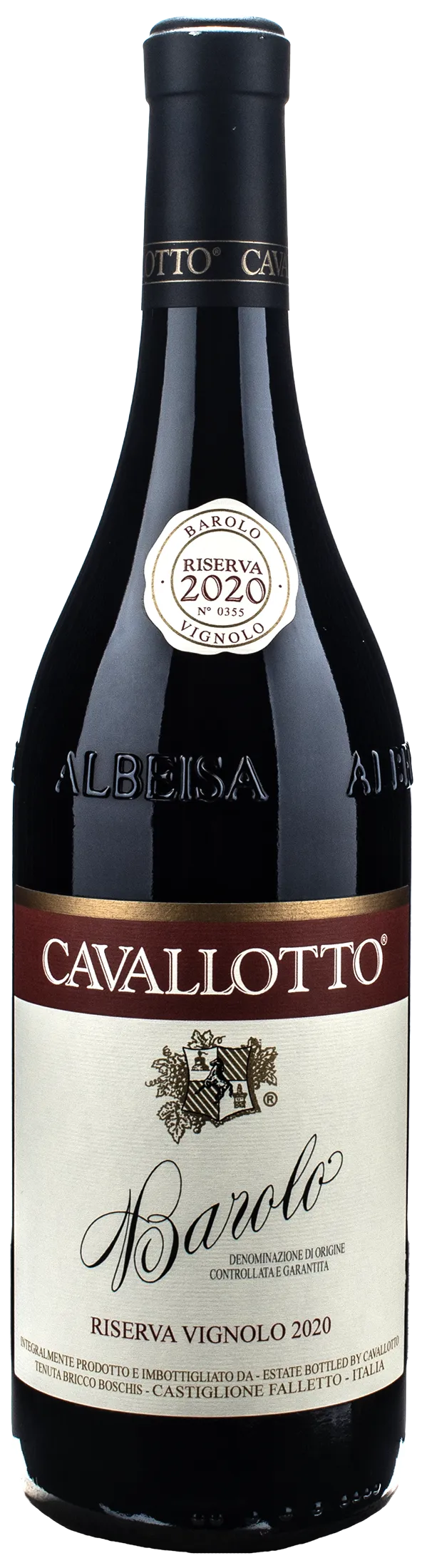
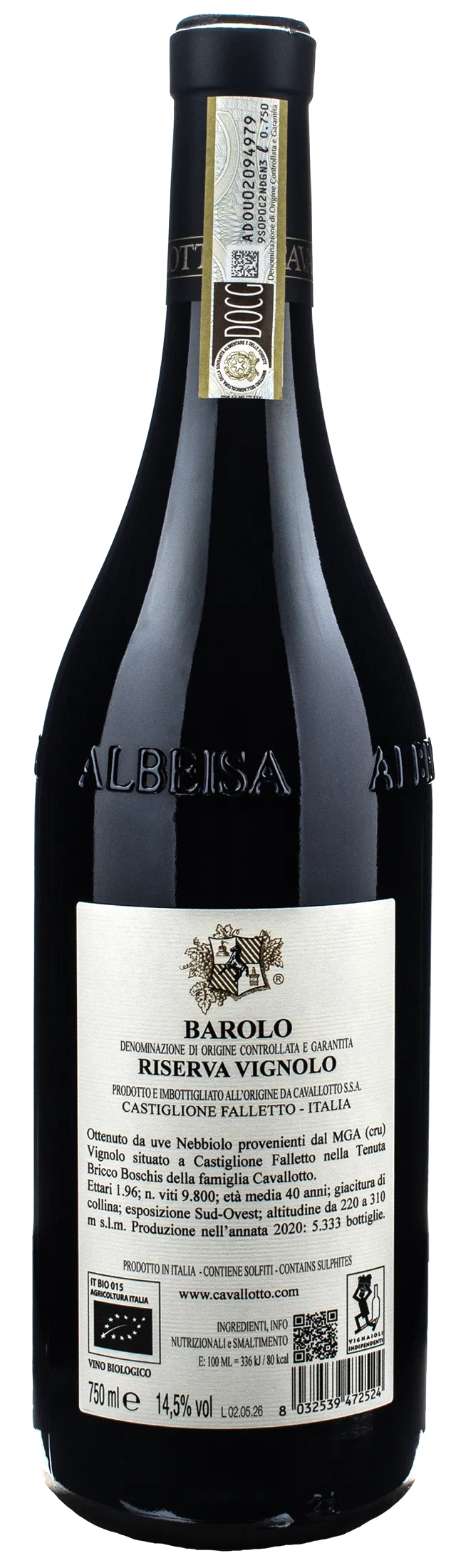
Barolo Vignolo Riserva 2020
| Denomination | DOCG Barolo Riserva |
|---|---|
| Size | 0,75 l |
| Alcohol content | 14.5% by volume |
| Area | Piedmont (Italy) |
| Grape varieties | 100% Nebbiolo |
| Aging | Aged for 48–60 months in Slavonian oak barrels; 12 months in bottle before release. |
- Name and grape variety: Barolo DOCG Riserva Vignolo from 100% Nebbiolo, 14.5% vol
- Origin and style: Still organic red wine produced in Castiglione Falletto, Piedmont
- Vinification: Use of indigenous yeasts, complete destemming, maceration between 18 and 30 days
- Ageing: Maturation for 48-60 months in Slavonian oak and 12 months in bottle
- Aroma and taste: Notes of jam, violet, mint and spices; harmonious flavour with soft tannins
Description
What kind of wine it is
Cavallotto Barolo Riserva Vignolo is a high-quality organic red wine from Piedmont. Made from Nebbiolo grapes, it displays an intense, bright garnet colour. On the nose, it reveals a complex bouquet of jammy fruits, violets, menthol notes and oriental spices. On the palate, it offers a harmonious and savoury sip, guided by a smooth tannic structure and a rich, deep persistence. Ideal for pairing with red meats or mature cheeses, it is also superbly enjoyed as a meditation wine.
Where it comes from
This wine originates in Castiglione Falletto, in the heart of Barolo, from the historic vineyards of the Vignolo Geographical Mention. Cavallotto cultivates these forty-year-old vines with low yields, thus enhancing superior aromatic definition. The strong connection with the soil delivers a rigorous and enveloping expression, ensuring an excellent ageing potential, although it is already pleasant and balanced in its youth.
How it is produced
The process involves total destemming and a slow fermentation activated exclusively by indigenous yeasts. The semi-submerged cap maceration lasts up to thirty days, optimising the natural extraction of polyphenols. After malolactic fermentation in cement tanks, the wine matures for a long period in large Slavonian oak barrels for almost five years. A measured final rest consolidates its complex and elegant flavour architecture.
History and Curiosities
The Barolo DOCG Riserva Vignolo embodies the excellence of Castiglione Falletto, celebrating a family legacy that has lovingly tended the Piedmontese vineyards since 1928. Made from Nebbiolo grapes fermented with indigenous yeasts, this wine enhances the terroir through expert submerged cap maceration. The long and traditional ageing in Slavonian oak barrels bestows it with a majestic ageing potential, offering from its youth a noble, soft and enveloping tannic structure.
Tasting notes

Perfume

Color

Taste
Serve at:
18 - 20 °C
Longevity:
10 - 15 years
Decanting time:
1 hour
- Start up year: 1928
- Oenologist: Alfio e Giuseppe Cavallotto
- Bottles produced: 100.000
- Hectares: 25
Today the children of Olivio – Laura, Giuseppe and Alfio, the 4th generation working the family farm – continue to exclusively vinify the grapes produced in their estate vineyards into DOC and DOCG wines: Barolo, Dolcetto d’Alba, Barbera d’Alba, Langhe Nebbiolo, Langhe Freisa, Langhe "Grign" made from Grignolino grapes, Langhe Chardonnay and "Pinner" made from Pinot Nero grapes. Read more


| Name | Cavallotto Barolo Riserva Vignolo 2020 |
|---|---|
| Type | Red organic still |
| Denomination | Barolo DOCG |
| Vintage | 2020 |
| Size | 0,75 l |
| Alcohol content | 14.5% by volume |
| Grape varieties | 100% Nebbiolo |
| Country | Italy |
| Region | Piedmont |
| Vendor | Cavallotto |
| Story | History and CuriositiesThe Barolo DOCG Riserva Vignolo embodies the excellence of Castiglione Falletto, celebrating a family legacy that has lovingly tended the Piedmontese vineyards since 1928. Made from Nebbiolo grapes fermented with indigenous yeasts, this wine enhances the terroir through expert submerged cap maceration. The long and traditional ageing in Slavonian oak barrels bestows it with a majestic ageing potential, offering from its youth a noble, soft and enveloping tannic structure. |
| Origin | Castiglione Falletto (CN), Piemonte |
| Yield per hectare | 38 hl/ha |
| Fermentation temperature | 29 °C |
| Fermentation | 18–30 days |
| Production technique | Total destemming; fermentation with indigenous yeasts; semi-submerged cap maceration |
| Wine making | Total destemming; fermentation with indigenous yeasts in horizontal tanks with a maximum controlled temperature of 29°C; semi-submerged cap maceration for 18–30 days; malolactic fermentation in cement tanks in the spring following the harvest; ageing for 48–60 months in Slavonian oak barrels. |
| Aging | Aged for 48–60 months in Slavonian oak barrels; 12 months in bottle before release. |
| Total acidity | 5.43 gr/L |
| PH | 3.43 |
| Dry extract | 30.1 gr/L |
| Allergens | Contains sulphites |