


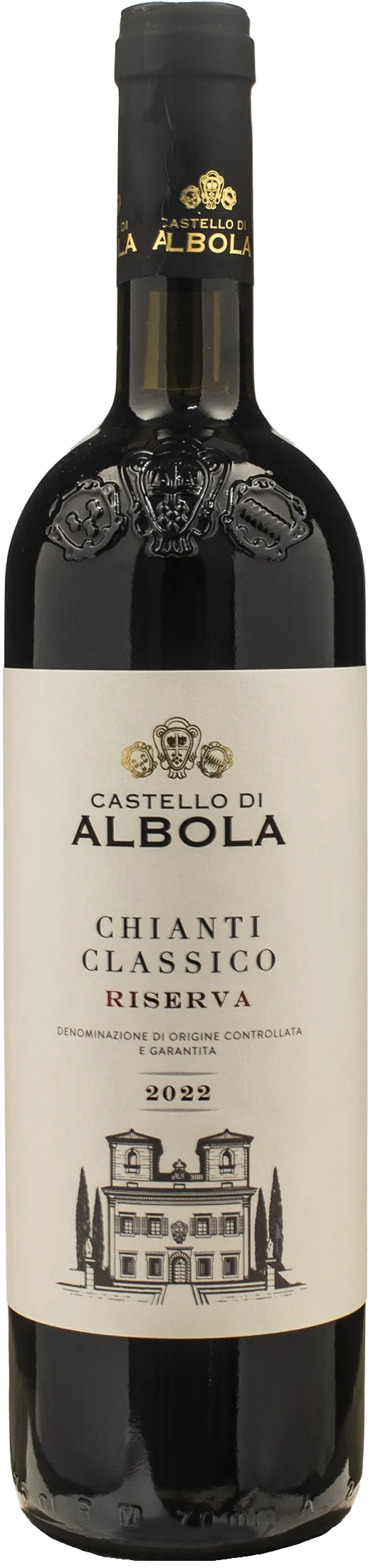
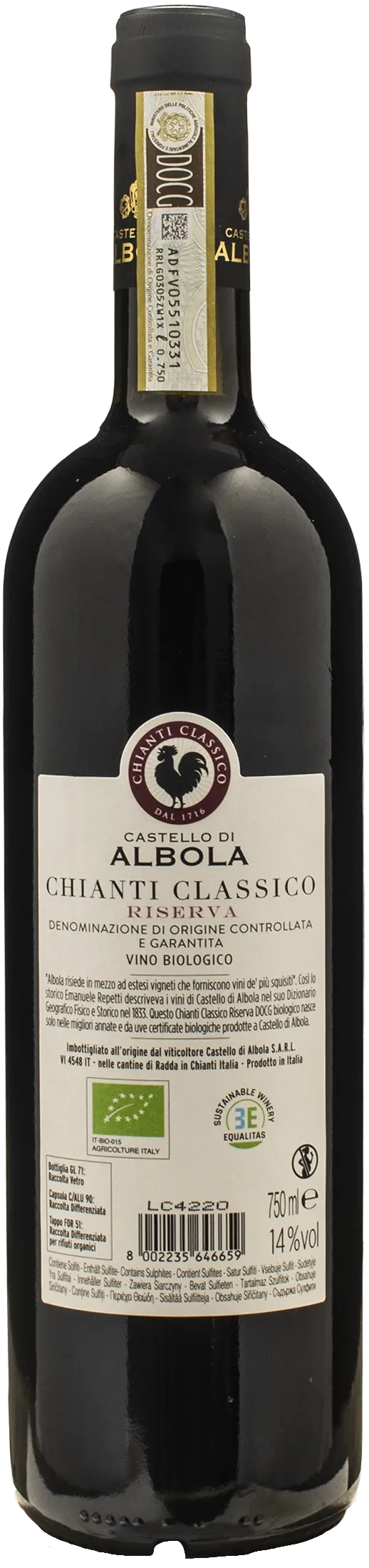
Castello di Albola
Chianti Classico Riserva 2022
| Denomination | DOCG Chianti Classico Riserva |
|---|---|
| Size | 0,75 l |
| Alcohol content | 14.0% by volume |
| Area | Tuscany (Italy) |
| Grape varieties | 95% Sangiovese, 5% Canaiolo Nero |
| Aging | Ageing lasts 20 months: 10% of the wine rests in Allier oak barriques, while 90% is aged in traditional Slavonian oak casks. This is followed by 12 months of maturation in stainless steel tanks and a further six months in the bottle. |
- Organic grape varieties: 95% Sangiovese, 5% Canaiolo Nero from Radda in Chianti
- Ageing: 20 months in Slavonian and Allier oak, followed by 12 months in stainless steel and 6 months in bottle
- Aromas: morello cherry, redcurrant and violet with hints of tobacco, herbs and Mediterranean scrub
- Palate: medium-bodied, lively acidity and fine tannins; elegant finish with a mineral note
- Serving and potential: 16–20°C, decant for 30–60 minutes; expected evolution 5–20 years
Description
What kind of wine it is
The Chianti Classico Riserva from Castello d’Albola is an organic red wine that clearly expresses the character of the Tuscan region. This blend of Sangiovese and Canaiolo Nero offers a layered bouquet, where notes of black cherry, redcurrant and violet stand out, enriched by hints of Mediterranean scrub and tobacco. On the palate, it is juicy and vibrant, supported by precise acidity and well-integrated tannins. Medium-bodied, the sip finishes with an elegant finale, enhanced by a pleasant mineral trail that adds depth.
Where it comes from
The grapes grow in Radda in Chianti, the historic heart of Chianti Classico. The vineyards stretch across the hills of Pian d’Albola, at an ideal altitude and with excellent southern exposure. The soils, well-drained and clay-limestone based, are rich in galestro and alberese of marine origin. This unique geological composition, combined with the hilly climate, gives the grapes a marked freshness on the palate and encourages the development of a clear aromatic profile, enhancing the territorial identity of this red.
How it is produced
After a rigorous manual harvest, the must ferments for about three weeks, then completes malolactic fermentation. Maturation lasts twenty months and takes place in a carefully selected mix of Slavonian oak barrels and a small proportion of Allier wood, which add subtle spicy notes without overpowering the fruit. A further twelve months in stainless steel containers and a long final rest allow the tannic structure and aromatic profile to stabilise perfectly, ensuring great elegance and longevity.
History and Curiosities
Born on the hills of Radda in Chianti, this superb organic DOCG Riserva expresses the true vocation of Castello d’Albola, an estate founded in 1979. Under the expert guidance of oenologist Alessandro Gallo, grapes grown between 350 and 650 metres give life to a masterpiece celebrated with 92 points by James Suckling. Its harmony is born from a patient 20-month maturation in Allier and Slavonian oak, completed by a period of rest in steel and in bottle; a precious evolution that bestows a vibrant elegance and finely integrated tannins upon the palate.
Awards
-
2022
 4
4Italian Sommelier Foundation (FIS) guide This has been one of the most prestigious wine guides in Italy for over 10 years.
-
2022
 3
3This guide is highly respected and offers the most comprehensive review of Italian wines. It has a long tradition and is based on blind tastings carried out by over 100 experts.
-
2022
 92
92/100
James Suckling is an influential American wine critic and journalist who worked at Wine Spectator for 30 years. He left the magazine in 2010 to start his own website and guidebook (JamesSuckling.com). He specialises in Italian and Bordeaux wines.
-
2022
 89
89/100
Wine spectator is the most influential wine guide on the internet.
Tasting notes

Perfume

Color

Taste
Serve at:
18 - 20 °C
Longevity:
05 - 10 years
Decanting time:
1 hour
- Start up year: 1979
- Oenologist: Alessandro Gallo
- Bottles produced: 750.000
- Hectares: 125
This is demonstrated by the interest of the Samminiati who, at the beginning of the 17th century when the male line of the Acciaiuoli had become extinct, took possession of Pian d’Albola thanks to the marriage between Ascanio Samminiati and Caterina Acciaiuoli. When Samminiati died, the property one again passed through a marital alliance to the Pazzis, one of the most noble and ancient Florentine families, who in fact kept it until the middle of the 19th century.
For the next hundred years Pian d’Abola, which in the general census of Chianti in 1832 was declared as one of the very few self-sufficient estates anywhere in the area, passed through several hands until 1940, when it was acquired by Prince Giovanni Ginori Conti. Forty years later it became the property of the Zonin Family, which initiated its second Renaissance. Read more


| Name | Castello Albola Chianti Classico Riserva 2022 |
|---|---|
| Type | Red organic still |
| Denomination | Chianti Classico DOCG |
| Vintage | 2022 |
| Size | 0,75 l |
| Alcohol content | 14.0% by volume |
| Grape varieties | 95% Sangiovese, 5% Canaiolo Nero |
| Country | Italy |
| Region | Tuscany |
| Vendor | Castello di Albola |
| Story | History and Curiosities Born on the hills of Radda in Chianti, this superb organic DOCG Riserva expresses the true vocation of Castello d’Albola, an estate founded in 1979. Under the expert guidance of oenologist Alessandro Gallo, grapes grown between 350 and 650 metres give life to a masterpiece celebrated with 92 points by James Suckling. Its harmony is born from a patient 20-month maturation in Allier and Slavonian oak, completed by a period of rest in steel and in bottle; a precious evolution that bestows a vibrant elegance and finely integrated tannins upon the palate. |
| Origin | Radda in Chianti (Siena), Italia |
| Soil composition | Well-structured soils with a clayey texture and the presence of stones (alberese); calcareous clay with fine gravel (galestro and alberese) from Pliocene marine deposits, with good internal drainage. |
| Cultivation system | Spurred cordon and Tuscan arched cane |
| Plants per hectare | 3,500 vines per hectare |
| Yield per hectare | 60 quintals of grapes per hectare |
| Harvest | Late September - early October |
| Fermentation | About 3 weeks |
| Production technique | Manual harvest; fermentation for about 3 weeks in vertical or horizontal vinifiers; malolactic fermentation completed; maturation in oak (Allier oak barriques and Slavonian oak barrels), then ageing in stainless steel and in bottle. |
| Wine making | The must, obtained from hand-picked grapes, is placed to ferment in horizontal vinifiers where it remains for about 3 weeks. Once malolactic fermentation is complete, the wine is immediately placed to mature in oak barrels. |
| Aging | Ageing lasts 20 months: 10% of the wine rests in Allier oak barriques, while 90% is aged in traditional Slavonian oak casks. This is followed by 12 months of maturation in stainless steel tanks and a further six months in the bottle. |
| Residual sugar | 1.1 gr/L |
| Allergens | Contains sulphites |