


Abbazia di Novacella
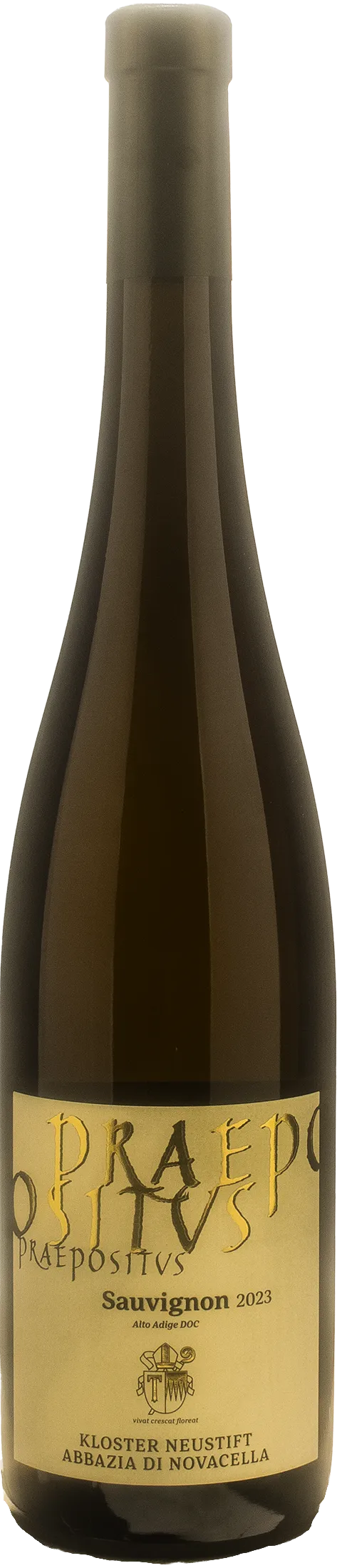
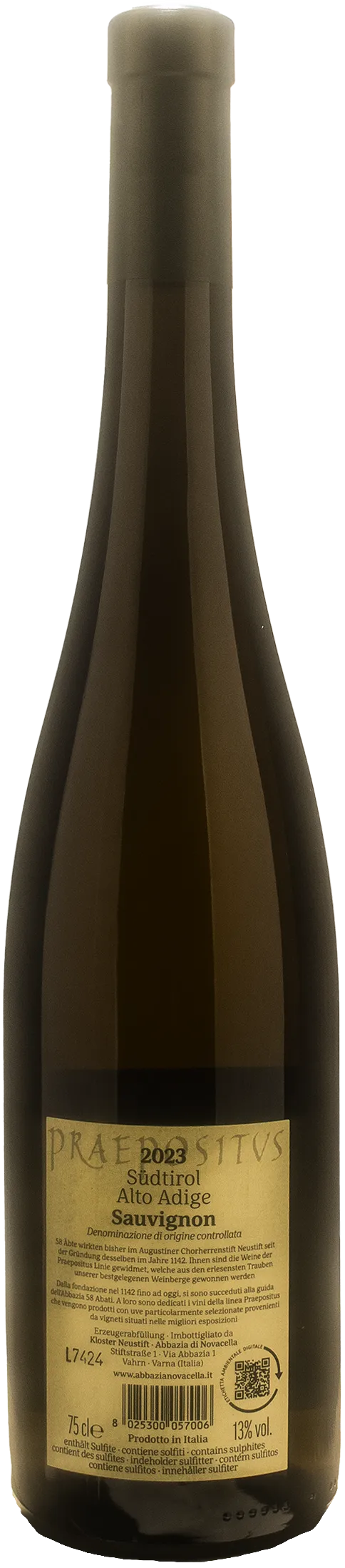
Praepositus Sauvignon 2023
| Denomination | DOC Alto Adige Sauvignon |
|---|---|
| Size | 0,75 l |
| Alcohol content | 13.0% by volume |
| Area | Trentino Alto Adige (Italy) |
| Grape varieties | 100% Sauvignon |
| Aging | Aged on the lees for about 10 months (in stainless steel and large wooden barrels), then further aged in the bottle for 2 months. |
- Grape variety and origin: 100% Sauvignon Blanc, Alto Adige DOC, 2023 harvest
- Characteristic aromas: notes of grapefruit, green pepper, elderflower, blackcurrant and vegetal nuances
- Taste profile: fresh and juicy flavour, balanced acidity, persistent and mineral finish
- High-altitude vineyards: located in Valle Isarco and Cornaiano between 350 and 900 metres, on mineral-rich soils
- Vinification technique: fermentation in steel and large barrels, aged for 10 months on the lees, 13% vol
Description
What kind of wine it is
Praepositus Sauvignon from Abbazia di Novacella is a still white wine from Alto Adige, an expression of the Sauvignon Blanc grape variety. To the eye, it displays a pale golden yellow colour with bright greenish highlights. On the nose, it weaves together notes of grapefruit and green pepper with elderflower, blackcurrant and vegetal nuances. On the palate, it is powerful and stimulating, driven by a mature acidity that lends great elegance. The sip is fresh, characterised by a long and savoury finish with a clear mineral imprint. Served at 10-12 °C, it is enhanced when paired with fish dishes, asparagus, white meats and fresh goat's cheeses.
Where it comes from
The grapes come from selected plots in the Isarco Valley, between Bressanone and Varna, and on the slopes of Cornaiano. The vineyards occupy south and south-west facing slopes, at an altitude between 350 and 900 metres. This range pays tribute to the priors of the monastery by highlighting the best-exposed soils. The cool microclimate, marked by strong temperature variations, favours aromatic precision. The soil is rich in minerals, composed of mica schist, paragneiss and quartzite, essential elements that give the sip its typical tension and savouriness.
How it is produced
The process begins in mid-September with a meticulous harvest and subsequent pressing. The must ferments at a controlled temperature in stainless steel tanks and large wooden barrels. Afterwards, the wine rests on its lees for about ten months, gaining greater structure and complexity of flavour. At the end of this prolonged ageing, the final blend is composed. The production process concludes with a two-month rest in the bottle, which helps to definitively stabilise the organoleptic profile.
History and Curiosities
The Praepositus line from the Abbey of Novacella pays tribute to the figure of the Provosts who have historically led the monastery, celebrating a centuries-old winemaking tradition. This excellent pure Sauvignon Blanc represents the quintessence of the finest high-altitude vineyards, cultivated on the mineral-rich soils of the Isarco Valley. The patient ageing on the lees in steel and wood gives this white wine an unparalleled complexity, a quality that earned it the silver medal at the renowned Concours Mondial de Bruxelles in 2021.
Tasting notes

Perfume

Color

Taste
Serve at:
10 - 12 °C
Longevity:
03 - 05 years
- Start up year: 1142
- Oenologist: Celestino Lucin
- Bottles produced: 900.000
- Hectares: 100
Also owned by the Abbey is a vineyard located in South Tyrol's main wine-growing area: the Marklhof estate in Cornaiano, on the 'wine road' near Bolzano. The sandy, dry soil and the airy climate of these hills make it possible to obtain excellent red wines, including a characteristic Kalterersee, a very fine Schiava and a very elegant Pinot Noir.
A third Novacella vineyard is located in Bolzano, around the ancient and tiny St. Mary's Monastery. Here, in the dry and very warm climate of the valley floor, a full-bodied dark Lagrein matures, which is particularly suitable for ageing.
In our wine cellar, the grapes from these three vineyards are raised to wines whose distinct character and quality has been rewarded by the loyalty of generations of friends and connoisseurs. Read more


| Name | Abbazia di Novacella Praepositus Sauvignon 2023 |
|---|---|
| Type | White still |
| Denomination | Alto Adige DOC |
| Vintage | 2023 |
| Size | 0,75 l |
| Alcohol content | 13.0% by volume |
| Grape varieties | 100% Sauvignon |
| Country | Italy |
| Region | Trentino Alto Adige |
| Vendor | Abbazia di Novacella |
| Story | History and Curiosities The Praepositus line from the Abbey of Novacella pays tribute to the figure of the Provosts who have historically led the monastery, celebrating a centuries-old winemaking tradition. This excellent pure Sauvignon Blanc represents the quintessence of the finest high-altitude vineyards, cultivated on the mineral-rich soils of the Isarco Valley. The patient ageing on the lees in steel and wood gives this white wine an unparalleled complexity, a quality that earned it the silver medal at the renowned Concours Mondial de Bruxelles in 2021. |
| Origin | Valle Isarco (agricultural area of Bressanone and Varna) and slopes in Cornaiano (Bolzano), South Tyrol, Italy |
| Climate | Cool microclimate with frequent temperature variations |
| Soil composition | Permeable moraine deposits, composed of mica schist, paragneiss and quartzite |
| Cultivation system | Guyot |
| Plants per hectare | 6000 |
| Yield per hectare | 6000 kg per hectare |
| Harvest | Around mid-September (autumn) |
| Fermentation temperature | 17–20 °C |
| Production technique | Fermentation at controlled temperature in stainless steel and large wooden barrels; ageing on the lees |
| Wine making | Harvest in mid-September with careful selection of the bunches and crushing; fermentation at controlled temperature (17–20 °C) for two-thirds in stainless steel tanks and the remaining part in large wooden barrels; ageing on the lees for about 10 months (steel and wood), blending and further ageing in bottle for 2 months before bottling and release to the market. |
| Aging | Aged on the lees for about 10 months (in stainless steel and large wooden barrels), then further aged in the bottle for 2 months. |
| Total acidity | 6.3 gr/L |
| Residual sugar | 2.5 gr/L |
| Allergens | Contains sulphites |